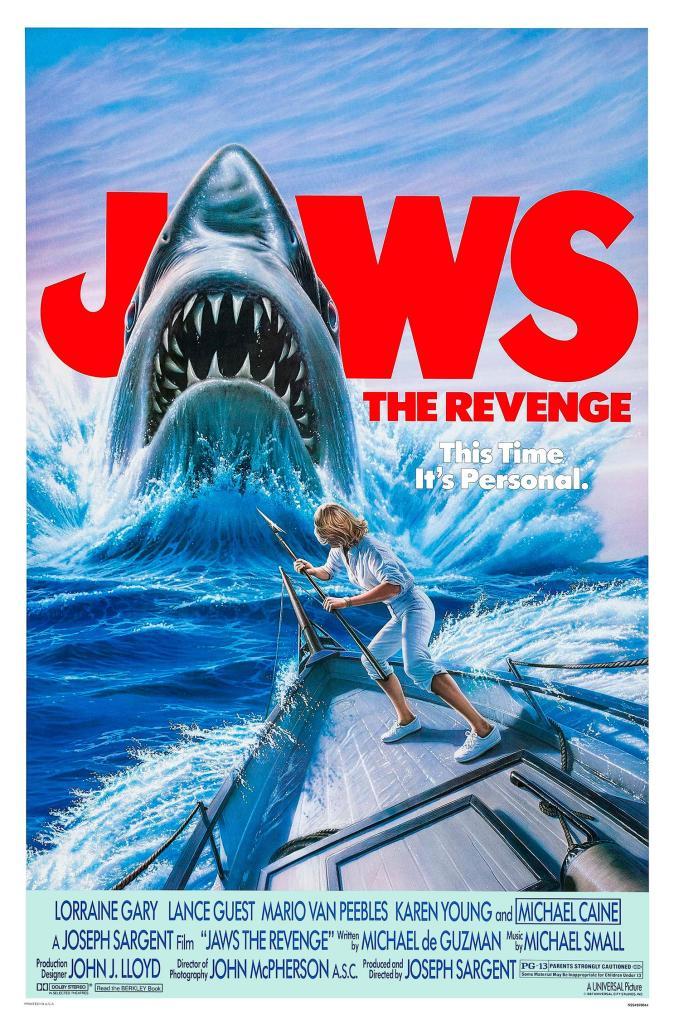
Jaws: the Revenge (1987) has been maligned from the moment it was released. I for one didn’t like it when I saw it in theaters. Prior to revisiting it for the first time in probably 38 years, I expected it to mirror the downward trajectory of the Superman quadrilogy. However, what happens in Jaws the Revenge doesn’t happen exactly the way I remembered. It’s not a good film by any means, but I enjoyed it more than Jaws 3 and I’d watch it again rather than badmouth it for another three decades.
Let’s address the two misconceptions with which you may be familiar. First is that a voodoo curse explains why a shark would seek revenge on the Brody family when Ellen (Lorraine Gary) moves to the Bahamas to be with her son, Michael (Lance Guest), and his family. There’s no voodoo curse. It’s a plot point (wisely) excised from the movie that remains in the movie’s novelization. Back in Amity, before the move, Michael uses the word “voodoo” in a conversation with his mother. It’s early, so I sighed, “Here we go…” but nothing ever comes from it and it’s not mentioned again.
The second misconception is that the shark follows Ellen from Amity to the Bahamas. This is harder to argue, but unless I missed it, there’s no indication that it’s the same shark that killed her other son, Sean (Mitchell Anderson.) That’s how it’s publicized (“This time it’s personal”) and that’s what Ellen believes, but there’s no evidence that it’s true. Why wouldn’t Ellen be traumatized by her experiences in Amity? I’m surprised she didn’t leave earlier. While her husband, Martin (Roy Scheider, who cameos via photograph and occasional flashback) died from a heart attack, she maintains it was fear that killed him.
There lies a fascinating concept, but one that no Hollywood studio in its right mind would ever execute. What if Jaws the Revenge wasn’t about a shark at all? What if it was about Ellen Brody’s mental state following everything she’s experienced? The most violent shark scenes in the existing movie are delivered through dreams, anyway. She could still have those and they could be terrifying. Besides, there’s only one big attack and death scene in the existing movie after Ellen moves to the Bahamas.
One of my personal misconceptions is that Michael Caine played the obligatory Quint role, which would be a horrible case of miscasting. I had no memory that his character, Hoagie, is simply a local pilot with a gambling problem in whom Ellen sees the glimmer of a new life. Dare I say, I found their developing relationship to be somewhat tender. Caine does not deliver a bad performance, even though he’s famously known for saying:
Won an Oscar, built a house, and had a great holiday. Not bad for a flop movie.
Yes, he was paid $1.5 million for only seven days work, but got to check something off his bucket list: making a movie in Hawaii. His price tag, plus that of convincing Gary to come out of retirement to reprise her role, contributed to an overall cost of $23-$30 million dollars, one of the most expensive for 1987. This certainly caused diminishing returns, but that shouldn’t be a factor in criticism of a film. I think my bad memories of Michael Caine come from another Peter Benchley adaptation, The Island (1980).
While I’ve applauded the omissions from the original screenplay so far, there’s one that I don’t like. Michael’s partner in his scientific research, Jake (Mario Van Peebles), miraculously survives being carried to the bottom of the ocean inside the stark’s mouth. I’m not saying he deserves to die, but someone does! Michael and Hoagie also survive close encounters and live to tell their stories. I know there was a major death in Amity at the beginning of the story, but it makes everything that happens in the Bahamas after that feel inconsequential…
…unless it all happened in Ellen Brody’s mind! She ultimately wouldn’t let anyone die in her dreams; therefore, they don’t die in real life. (I’m going to stick to that theory.)
If you read quotes from Jaws: the Revenge, you’d think the dialog is awful. Well, most of those quotes come from Jake, I assume because Van Peebles wrote his own role. They didn’t bother me while watching the movie because most of the time, I couldn’t understand what is was saying, anyway! A few other lines made me grimace, but they work for me in the context of the overall vibe of the film.
One analogy I’ll make for Jaws the Revenge is its own soundtrack. It utilizes John Williams’s theme just enough, but takes it in a new direction. Therefore, there’s a link to the 17-year old film, but it’s not exactly the same thing. In Michael Small’s score, the deep “dun-duns” don’t increase in speed and are followed by the usual melody of strings, but when those stop, there’s been a consistently pulsing beat beneath that keeps the music movie forward. It’s more 1980s than 1970s. That’s the movie. It’s linked to the past, doesn’t really gain any speed, and is much more of the 80s than the 70s. There have been far worse sequels than this one!

 Classic Horrors Club
Leave a reply to classichorrors Cancel reply