Written by Lucio Fulci and Robert Gianviti and Gianfranco Clerici
Directed by Lucio Fulci
Starring Florinda Bolkan, Barbara Bouchet, Tomas Milian, Irene Papas, Marc Porel
Released September 22, 1972 (Italy)
RT 102 min.
Home Video Arrow Video
Classic Horrors rating = 7 (out of 10)
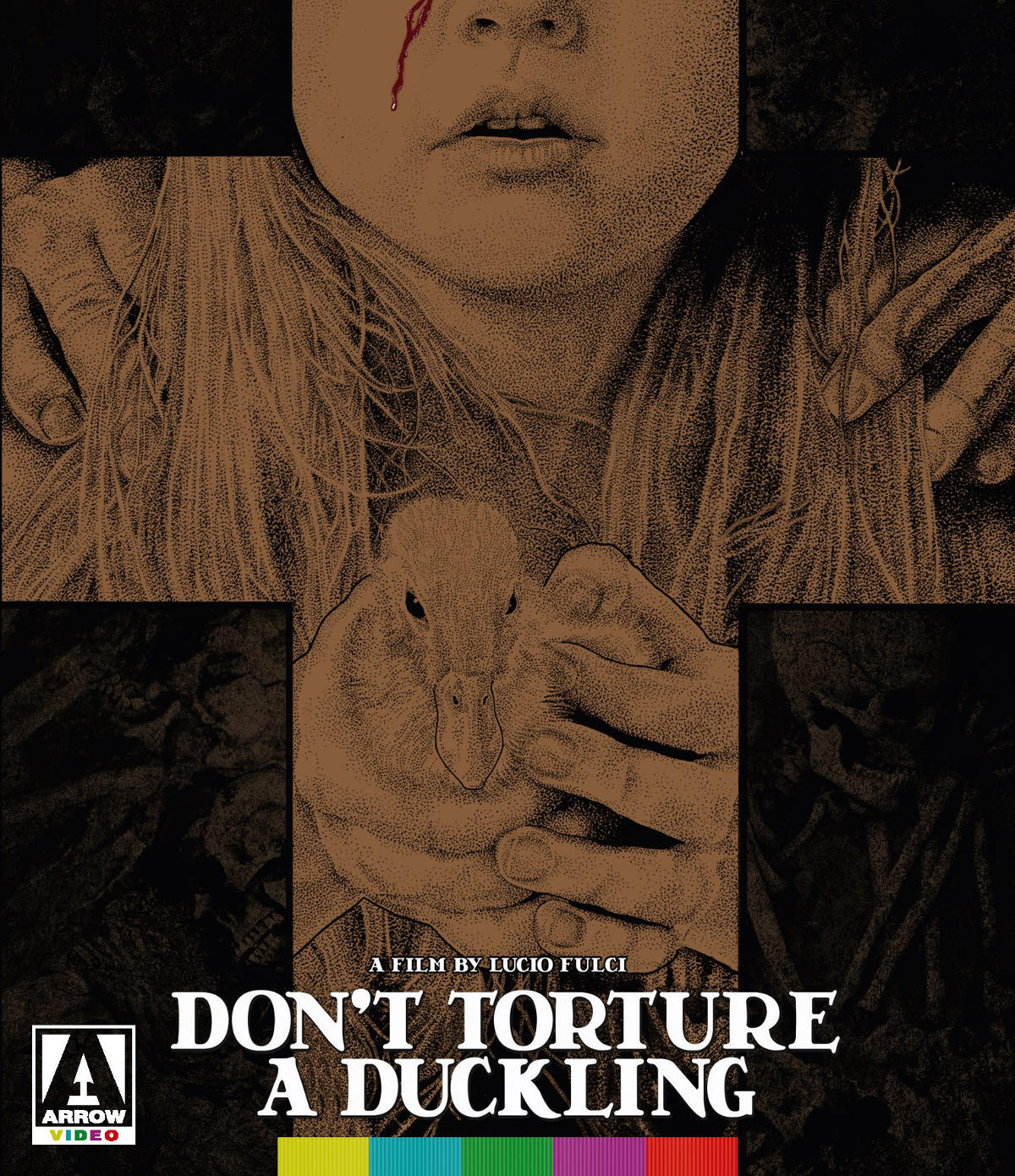
Prior to watching Don’t Torture a Duckling (1972), I was familiar with Lucio Fulci only through a handful of the more horrific films he made almost a decade later, the ones like Zombie (1979), City of the Living Dead (1980) and The Beyond (1981). That’s not to say Don’t Torture a Duckling isn’t horrific; the subject matter and themes sometimes seem more disturbing than those of his later gorefests. However, its serial killer mystery is more firmly rooted in the crime-thriller elements of giallo than in the supernatural elements of horror.
If, like me, you feel somewhat disoriented by the context of the movie, the new dual format release from Arrow is an excellent companion for experiencing it. First, the audio commentary by author Troy Howarth (So Deadly, So Perverse: 50 Years of Italian Giallo Films) provides a wealth of information about the movie’s stars and creators. Then, in a “video discussion,” author Mikel J. Koven (La Dolce Morto: Vernacular Cinema & the Italian Giallo Film) provides a history of giallo and how Don’t Torture a Duckling is both similar and unique to the subgenre.
A recurring theme in the bonus materials is the claim that writer-director Lucio Fulci was a misogynist. In fact, critic Kat Ellinger uses the forum of an entire 20-minute video essay to dispute the accusation. If second and third hand reports aren’t authentic enough, included in the package is an audio interview with Fulci himself. Recorded in August of 1988 in response to a list of questions from Italian journalist Gaetano Mistretta, Fulci leads us through his career and comments on how he has been characterized, in what equals a 30-minute+ interview.
The first thing I noticed about Don’t Torture a Duckling was its haunting score by Riz Ortolani. The movie opens with it playing strong as an angled close-up shows a woman digging into the ground with her bare hands. She uncovers the skeleton of a baby, immediately setting the tone for what’s to come in the next 108 minutes. This occurs just off the raised highway of the Italian Autostrade. I was struck by this primitive action that was taking place beside such a symbol of modern civilization.
Before long, I realized the significance of the juxtaposition. The story takes place outside modern civilization. The fictional village in southern Italy is removed from the development of the north. In his video discussion, Koven explains the culture clash between the two regions that began in the 1950s. Although the north drew migrant workers from the south, some remained, ambivalent toward the modern age and the crime, corruption, etc. that came with it. He says this is a trope in genre films of the 1960s and 1970s. Modernity is exciting, but it’s also dangerous.
This particular village chooses to live by superstition. Mob mentality rules when a suspect is arrested for the murder of a young boy. It’s a mentally challenged resident who, truth be told, the residents would probably like to disappear, anyway. Barra (Vito Passeri) is only the first “outsider” who will be accused as the bodies of more missing boys are located. Next is the local “witch,” Maclara (Florinda Bolkan). She’s simple like Barra in that she claims responsibility for the murders because she used voodoo dolls of the victims. She didn’t literally kill them, though.

In a memorable, yet physically painful to watch, scene, the fathers of the dead boys take action that represents the village’s outrage and brutally attack Maclara. Fulci masterfully films the sequence, effectively utilizing pop music playing on the radio from one of the attacker’s cars. It’s heartbreaking. I felt great sorrow for the naïve woman; however, I also felt sorrow for the villagers. It’s not a stretch to relate this behavior to current events, when, unfortunately, mob mentality and ignorance sometimes still seem to rear their ugly heads even today.
Late in the movie, with no suspects remaining, the two “heroes” of Don’t Torture a Duckling finally emerge. They’ve been there all along, but their ultimate roles in the story are not defined until only 15 or 20 minutes remain. Interestingly, they’re also outsiders. Patrizia (Barbara Bouchet) is a mysterious transplant from the north that until now has been the story’s biggest red herring. Andrea Martelli (Tomas Milian) is a reporter that’s been on the edge of the mystery, but finally takes charge when he finds a clue connecting Patrizia to the murders.
Who does that leave as the killer? In his commentary, Howarth indicates the identity would not be a spoiler for fans of the giallo formula. I suspected correctly early in the movie simply because I thought it would be a great twist. While I still feel that way, I was less clear about the killer’s motives. In retrospect, it makes sense, and the other participants in the bonus materials seem to be in agreement. However, I’m just saying that watching the movie on my own, I didn’t immediately understand the killer’s reasoning other than he/she was perhaps insane.
In the end, the killer gets what’s coming to ‘em. In a scene that I’ll argue is as controversial as that of Maclara’s beating, he/she meets an extended, somewhat surrealistic end. I believe Fulci shoots it this way so that it’s a fitting punishment for the crimes committed, especially based on the identity of the killer. If most fans of the subgenre lock on to its horror and gory excess, as Howarth says, then the finale of Don’t Torture a Duckling should satisfy. If Fulci is known for his disturbing images, this is a good example of why.
This film is supposedly one of Fulci’s favorites, although in his audio interview, he says his best film was The Conspiracy of Torture (1969). For a man who perhaps doesn’t have the most positive reputation, I really appreciated some of his comments. For example, he says that what you choose to do should never be the means to an end; it should be the end. As for what inspires him, he says, yes, Lovecraft and Poe, but the biggest influence is your imagination. He also claims responsibility of all of his movies, “Even my worst films are mine.”
I highly recommend Arrow’s release of Don’t Torture a Duckling. An early example of giallo following the success of Dario Argento’s The Bird with the Crystal Plumage, it is a favorite of the few I have seen. I also highly recommend Koven’s video discussion. He provides nearly 30 minutes of fascinating educational information that I’d call “Giallo 101.” For the first time, I feel like I truly understand what the subgenre is all about. After experiencing the Blu-ray and its bonus material, I’m eager to explore more of what’s out there.
Street Date: 10-3-2017
Bonus Materials:
- High Definition Blu-ray (1080p) and Standard Definition DVD presentations
- Original mono Italian and English soundtracks (lossless on the Blu-ray Disc)
- English subtitles for the Italian soundtrack
- Optional English subtitles for the deaf and hard of hearing for the English soundtrack
- New audio commentary by Troy Howarth, author of So Deadly, So Perverse: 50 Years of Italian Giallo Films
- The Blood of Innocents, a new video discussion with Mikel J. Koven, author of La Dolce Morte: Vernacular Cinema and the Italian Giallo Film
- very (Wo)man Their Own Hell, a new video essay by critic Kat Ellinger
- Interviews with co-writer/director Lucio Fulci, actor Florinda Bolkan, cinematographer Sergio D’Offizi, assistant editor Bruno Micheli and assistant makeup artist Maurizio Trani
- Reversible sleeve featuring original and newly commissioned artwork by Timothy Pittides
- FIRST PRESSING ONLY: Collector’s booklet with new writing on the film by Barry Forshaw and Howard Hughes
 Classic Horrors Club
Leave a comment