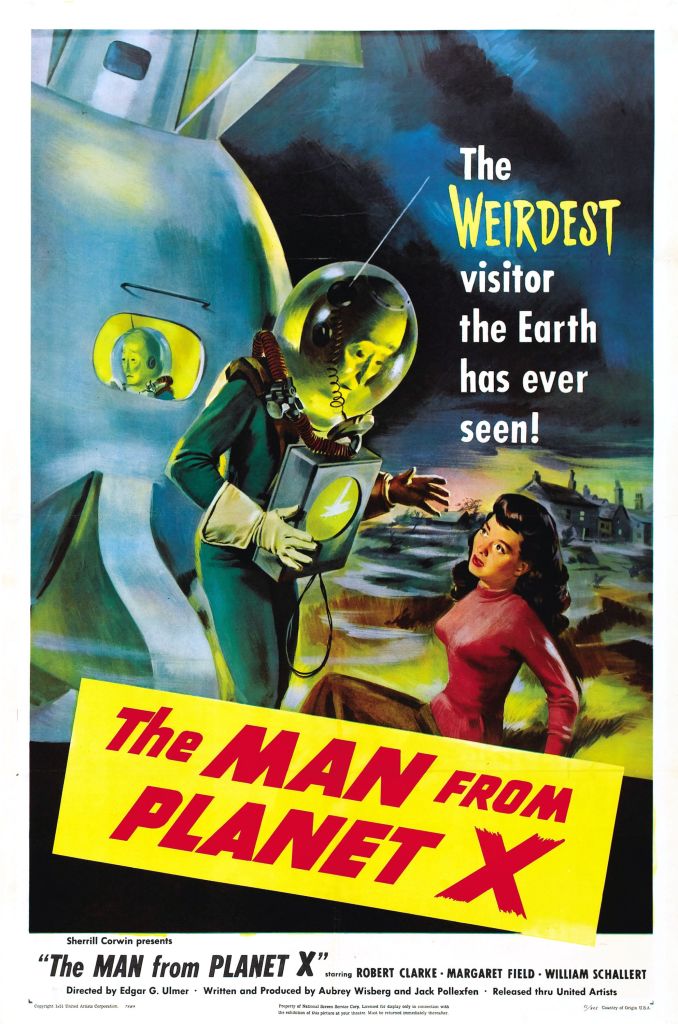
The Man from Planet X (1951) begins with the end. In a tower sprouting from the fog of the Scottish moors, John Lawrence (Robert Clarke) welcomes us into the movie with his internal monologue:
I don’t know if she’s still alive or not. They’ve had her now for the past 24 hours. I’m equally uncertain as to the fate of her father, Professor Elliott. Both are probably dead. The odds are 100 to 1 I too will be dead before another sun rises. But tonight, I’m going to try to fight for my life and those larger issues so perilously at stake affecting all mankind. If I fail, which seems most likely, the consequences to humanity defy the imagination.
Not altogether original, this method of introduction usually works well for engaging the audience. We shortly learn that Lawrence is a reporter from the United States who had been “in a position to observe the terror from its inception.” He arrived on foreign soil after an observatory near Los Angeles spotted a new planet slowly heading for Earth and sent him to interview Professor Elliott (Raymond Bond.)
Coincidently, Elliott’s daughter, Enid (Margaret Field) is an old acquaintance and their relationship during his visit is probably the reason IMDb assigns the Romance category to those of Horror and Sci-Fi. Their connection, however, is no more or less than any other Atomic Age sci-fi movie where two characters bond during a world-ending threat.
Specifically, the threat is a short humanoid alien with a large, squished head inside a clear helmet. Enid puts it more scientifically, saying its face looks “distorted by the pressure.” The alien apparently can’t breathe oxygen and is always fiddling with a knob to adjust whatever it is he inhales inside his suit. Lawrence turns the knob when it seems stuck, presumabley saving its life and offering a peaceful greeting.
However, Dr. Mears (William Schallert) had arrived earlier on Elliott’s doorstep, destitute. He was evidently an old student of the professor who’s fond of him and doesn’t notice the obvious: he’s a selfish, greedy, conniving villain whose subsequent cruel treatment of the alien obliterates any good will previously earned… and that means, Earth may also be obliterated when the planet collides with it.
As despicable as he is, Mears is my favorite thing about The Man from Planet X. Early in his career and possibly only his third credited film appearance, neither Schallert nor his singular voice is instantly recognizable. Knowing the long career ahead, it’s fun to see him in one of his first roles, lurking around corners to spy on other characters and uttering such dialogue as:
A man who controls this formula controls the industry of the world.
He’ll get what’s coming to him, but almost everyone except Lawrence does, hence the opening scene of the movie. The alien controls technology that shines a light in one’s eyes, turning them into zombie slaves. I’m not sure why it’s doing this, but I guess they’re digging out his crashed spaceship so he can go home rather than planting flowers in the Scottish countryside.
It’s a fun movie, but except for Mears/Schallert nudging it over the edge, it’s about as average as any other 50s sci-fi matinee. Most of the time, the effort, led by familiar genre director Edgar G. Ulmer, exhibits a look beyond its budget. However, to save money, sets from Joan of Arc (1948) were repurposed. At times, the backdrops look like they’re right behind the actors, giving the impression we’re watching a stage play.

Although I watched The Man from Planet X streaming on Amazon Prime, it’s also available on Blu-ray from Shout Factory. Originally released in San Francisco on March 9, 1951, this year marks its 75th anniversary.

 Classic Horrors Club
Leave a comment