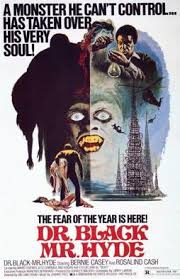
Regardless of color, once Hollywood discovers a hit, they milk it for all it’s worth. In 1972, Blacula opened the coffin for a sub-genre of the already popular “blaxplitation” film. Within a span of five years, other creatures joined the African American version of Dracula on the big screen, Blackenstein (1973), Abby (1974), Sugar Hill (1974), and J.D.’s Revenge (1976) among them.
After watching Dr. Black, Mr. Hyde (1976), I’ve now seen eight of the nine 1970s blaxploitation horror films of which I’m aware. They’ve ranged from the beautifully moving Ganja & Hess (1973) to the hideously ugly Blackenstein. Like other sub-genres before and after, blaxploitation horror offered diminishing returns. Coming near the end of the cycle, Dr. Black, Mr. Hyde signals one that is fading quickly.
Interestingly, it’s directed by the man who started it all with Blacula, William Crain. That’s to say that it’s not an awful movie. In fact, it features some fun moments. Minimal research shows that it’s been dissected and examined for cultural subtext, so we won’t discuss much of that here. I’m more interested in its value for entertainment, specifically as a horror film, or perhaps parody of one.
This Jekyll, Dr. Henry Pride (Bernie Casey), is generally a good man. He’s focused on a selfless cause. He wants to cure cirrhosis of the liver, and he believes awards should come from the people he’s cured, not from his peers. The problem is, he hasn’t cured anyone. When he injects a colorful serum into a lab rat one night, it changes its pigmentation and kills all the others by morning.
Like most scientists in horror movies, he’s obsessed and wants to try the serum on a terminal patient. His colleague, Dr. Billie Worth (Rosalind Cash) warns him:
You can’t try that serum on a human. It’s not right!
Nevertheless, when he does it anyway, the patient sits up suddenly and grabs the nurse. Her hair has turned gray and her eyes are white. Just as suddenly, she lies back… dead. Of course, the next logical step is to try the serum on himself. I mean, he’s spent five whole years of work with no results and doesn’t know when he’s going to get another human patient. At home, he injects himself, screams in pain, and collapses.
When he rises, he’s become monstrous. I don’t know if it’s intended that the serum temporarily turns him Caucasian. Sure, he’s pale, perhaps albino; however, when he’s later described to the authorities, it’s as a “white man.” Anyway, Pride’s alter ego is as selfless as he is. He immediately heads for the Moonlight Lounge, where a troubled prostitute, Linda Monte (Marie O’Henry), that he’s been trying to “save” as Dr. Pride, hangs out and endures harassing behavior by the clientele.
A pimp named Silky (Stu Gilliam) is painted as the bad guy, yet several hookers become collateral damage as newspaper headlines report “3 New Murders in Watts.” Two of Pride’s kills are notable. During his first visit to the Moonlight Lounge, as a man rushes him with knife raised, he grabs him by the crotch, lifts him into the air, and tosses him across the bar. Then, Silky meets his demise as Pride pins him against an alley wall with his car. When he backs up and Silky slides down, he revs forward, assumably smashing his head with the front fender.
Speaking of the car, I think it had some of the serum injected into the gas tank. When the Pride-monster first leaves his house, he’s driving a long, white, vintage Rolls-Royce. It seems like a strange car for Dr. Pride to drive every day, and I’m pretty sure he’s driving something else as he tools around town. The Rolls-Royce suits his alter ego and looks terrific on the dark, seedy neighborhood streets of Los Angeles.
I enjoyed Dr. Black, Mr. Hyde. I’ll leave the serious cultural analysis to those more qualified. Some of its relevance seems obvious to me, yet I sense there’s context that’s more subtle. The ending is over the top, perhaps more than is required for the type of monster. It instantly evokes a bigger creature, which explains my earlier comment that the movie may be a parody.
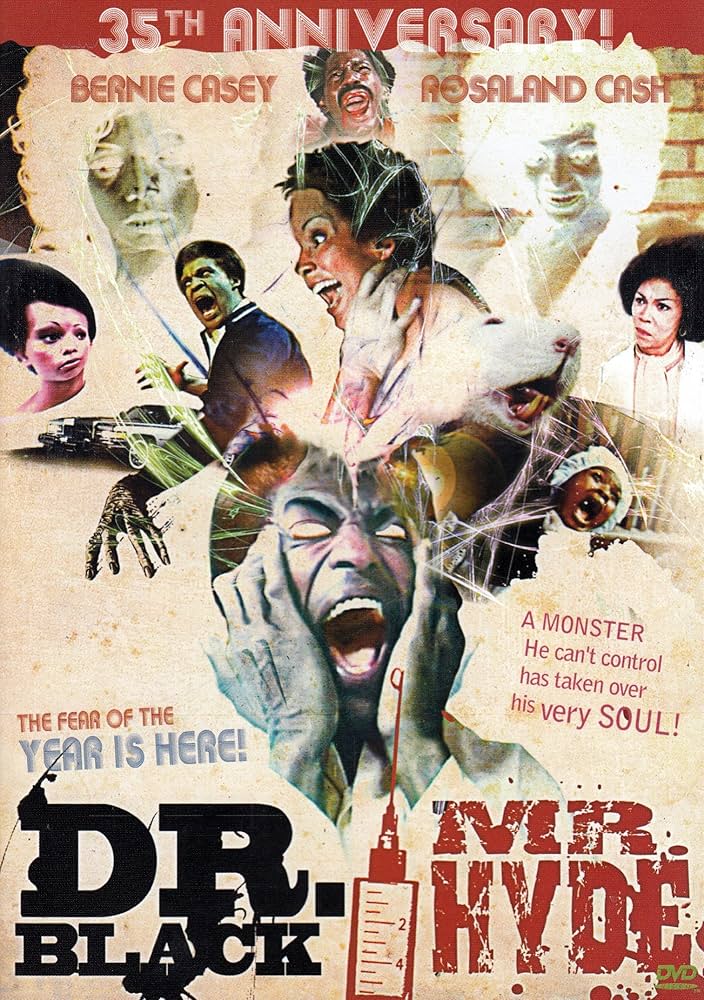
2026 marks the 50th anniversary of the release of Dr. Black, Mr. Hyde, which premiered in Atlanta, Georgia, on February 6, 1976. It’s available on DVD from Vci Video.

 Classic Horrors Club
Leave a comment