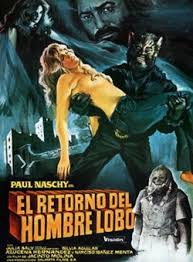
Unseen since Night of the Howling Beast (1975), aka The Werewolf & the Yeti, and following at least 20 non-Waldemar Daninsky movies, Paul Naschy, his character and his curse, return in Night of the Werewolf, aka El retorno del hombre lobo, aka The Craving. This was the first Daninky film Naschy directed himself, so it’s no surprise he claimed it was his favorite. Knowing my tastes, it’s also no surprise that it’s not my favorite.
In what is essentially a reboot of the series, Naschy borrows liberally from previous efforts, largely The Werewolf vs. the Vampire Woman (1972), aka La noche de Walopurgis. That movie in and of itself is not a favorite, but Night of the Werewolf makes some improvements to it. It also utilizes plot points from Curse of the Devil (1973), which we discussed last week. Elizabeth Bathory is featured in both. In Curse, though, she’s burned at the stake in the past, while in Night, she’s resurrected in the present.
Also, in Night, Daninky is a servant of Bathory’s (Julia Saly), instead of her punisher. Therefore, when she rises in the present, she needs his power to achieve her evil plans and manipulates his true love, Karen (Azucena Hernandez), into helping her set a trap. Freed from eternal rest by a couple of grave robbers, Daninsky is free of Bathory for a while before that, and is the hero we recognize.
That is, until the arrival of three young women: the aforementioned Karen, Barbara (Pilar Alcon), and Erika (Silvia Aguilar.) Erika is as evil as Bathory, murdering a professor to steal the medallion that will wake her when it’s bled upon. That’s Barbara’s purpose in the film, to be hung naked upside-down so Erika can slit her throat, blood can flow, and steam can start emitting from Bathory’s coffin.
There’s also the character of Mircaya (Beatriz Elorrieta), a scarred woman that Daninsky apparently rescued from a modern-day witch burning. With her pining over Daninsky, I expected her to end up being his true love, not Karen. Spoiler alert, she’s not. She becomes just another female vampire to do Bathory’s bidding.
One of the things I liked about Night (and Curse of the Devil, too, although I failed to mention it last week) is its workaround for a full moon rising only once a month. The way the story is told in linear order, it seems like the moon is full every night. However, if you’re paying attention, you notice that a month has passed in between. People and circumstances have changed.
One of the things I don’t like about Night is the werewolf makeup. It’s arguably “the best,” but to me looks like decent below the forehead makeup with a hairy “hat” with ears that sits on top of Naschy’s head. There’s a traditional lap dissolve transformation; however, there’s a cleverer use of cinematography when Naschy crawls behind a couch, then two hairy paws reach up from behind. The transformations vary in another way, too. One time, he’s in obvious pain, stumbling around and tearing up the place; another, he lies quietly on the ground.
There’s no doubt Night of the Werewolf is a gorgeous film. It’s now the 80s instead of the 70s, though, and it’s missing some of the charm I enjoy in a down-and-dirty Eurohorror film. It’s also bloodier (and the effects are quite good.) But it’s also 15 minutes longer than the earlier Daninsky movies and would benefit from a little more editorial restraint. Again, though, it’s Naschy’s baby and he got to do with it what he wanted, so it deserves credit for that.


 Classic Horrors Club
Leave a comment