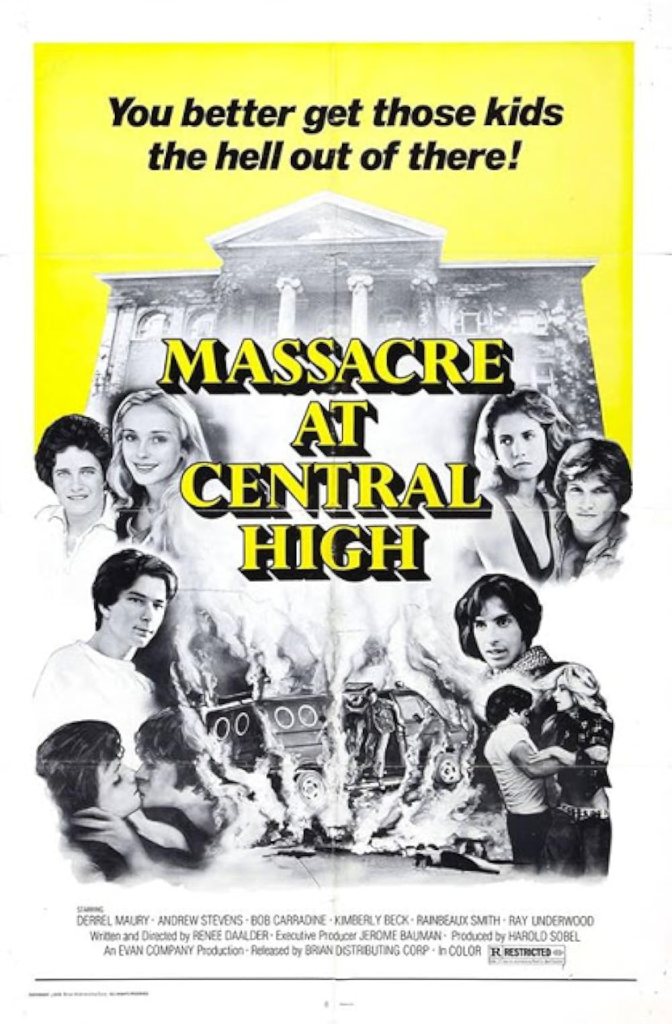
Drama? Thriller? Horror? Let’s try fantasy… This movie takes place in the land of adult actors playing high school students while at the same time the story is totally absent of any adult characters. There are no teachers at the high school and there are no adults in town. That is, until the very end when a few adults appear in the gymnasium for the Student/Alumni Prom.
With the lack of adults comes the lack of police presence. Even though one of the “kids” mentions an investigation, we don’t even hear a siren. Again, that’s not until the very end when an unreported event suddenly causes the cavalry to arrive just as the end credits begin to roll. This is not necessarily a complaint. It’s just something you must accept, or you won’t appreciate Massacre at Central High (1976). Is there anything to appreciate about it, though?
It’s almost as if the kids have killed all the adults. While there’s the typical social structure of any high school with the bullies and misfits, there’s no level in between. Both sides acknowledge the pecking order but are impotent in doing anything about it. That is, until David (Derrel Maury) arrives. He’s the perfect teen and, when he starts fighting back on behalf of the little guy, he’s perceived by them as a sort of savior…
…while also perceived as a threat by the bullies. Knocking the jack from underneath the car he’s repairing and crushing his legs is nothing to them. There’re no punishments and no consequences. Well, normally. David turns out to be a psychopath and ultimately takes his revenge, not only on the bad guys, but the good guys who rise to become the bad guys when their predecessors are dispatched.
The catch is that David and one of the bullies, Mark (Andrew Stevens), go way back. We don’t know the details, but David did something to save Mark when they were in “that place,” which Mark says they can now think of as only a bad dream. Because of their bond, Mark will do everything he can to protect David, and David will keep Mark off his hit list. Before that, though, Mark tries to convince David that he needs to accept a new life.
If you find some interesting ideas here, their impact may be lessened by the movie’s matter-of-fact presentation. No judgment is passed, and the lines between right and wrong are blurred as the two social powers make their switch. This leaves us as cold observers with complete control over how we want to interpret it. It’s an example of rough 1970s filmmaking with more bits of random nudity than scenes of graphic violence.
One plot point I particularly liked, although it seems a little obvious, is that during a conversation with Mark’s girlfriend, Theresa (Kimberly Beck), David talks about the anger that builds inside him. She tells him he needs a release, and he replies that he has one: he runs. Indeed, we see him in action wearing his track suit during the opening credits as well as a couple other times before his “accident.” It’s only after the accident that his killing spree begins.
There’s something unique about Massacre at Central High. At times, the tone reminds me of Targets (1968), in which the killer casually prepares for the carnage, but no suspense is used to intensify the events. David otherwise goes about his business as usual. I don’t make any political comparisons to past or current events, but some people have. In fact, Roger Ebert apparently called this the best movie of 1976. I don’t know about that, but it is sticking with me.

 Classic Horrors Club
Leave a comment