

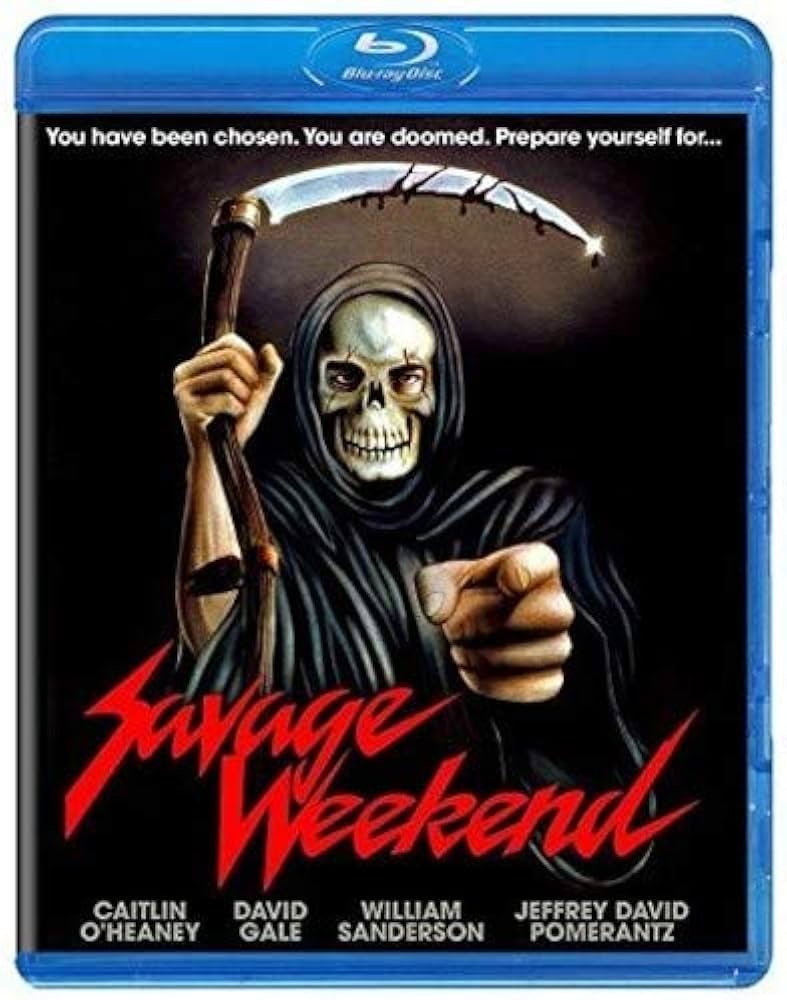
Upon first watch, one would assume that Savage Weekend (1979) is a typical slasher film, albeit an early one. When you learn it was filmed in 1976 and preceded Halloween (1978) and Friday the 13th(1980), you realize it was instead a proto-slasher film ahead of its time, much like Black Christmas (1974.) In either case, it wasn’t intended to be a slasher of any kind, but when investors retracted the majority of funds promised to David Paulsen for another movie, he wrote a horror movie “that could be made with few resources,” fashioned around “a variety of bizarre and extravagant murder sequences.”
Regardless of categorization or placement in horror history, I’m not sure what to make of it. On one hand, it has a grimy look and feel of something like Devil Times Five (1974) with acting that’s either not good or remarkably natural. On the other, it sacrifices details that establish the characters and story so we’re left with no choice but to read plot summaries online. A thorough note-taker when watching a movie before writing about it, I had to stop and pay attention, leaving it to memory for this discussion. (Which is why I’m writing about it the day after… the memories tend to pass quickly these days.)
Here’s my dilemma: is the vagueness due to poor writing, or are we intended to retrieve clues along the way? For example, we meet Marie Pettis (Marilyn Hamlin) at the beginning when her son’s father, Greg (Jeff Pomerantz) picks him up for the weekend. At this point we know nothing about their relationship; we assume they’ve gone their separate ways. Who are the other people with Marie? There’s a younger woman, Shirley (Caitlin O’Heaney), and an openly gay man, Nicky (Christopher Allport.) And who is the stockbroker, Robert (Jim Doerr) who’s coming up for the weekend?
Where are they going? It’s obviously some kind of weekend getaway to upstate New York, but at who’s house are they staying? Who is the handyman that takes Robert and Marie onto the water while Jay Alsop (Devin Goldenberg) watches them through binoculars? We learn the most about Otis (William Sanderson) than anyone because he’s the subject of the local rumor that he assaulted a young woman and may have murdered her. Otis lurks everywhere and since he picked up a chainsaw in the opening scene and headed toward the camera (and a helpless woman), we assume he’s the killer.
I began to suspect Otis wasn’t the killer when, from the point of view of the killer, we see them pick up a mask that the gang purchased at a gas stop along the way. Writer-producer-director David Paulson clearly intended for us to think he was the killer; however, if he was, why would so much time be spent hiding his identity during his murder spree? My instincts were right, but with limited suspects, does the reveal make sense? One one hand, it does because, in retrospect, there are clues. On the other, it doesn’t. It seems forced just to act as a twist in the plot.
Muddying the water is the other angle of the film: sex. The women bare their breasts frequently, Jay strips and climbs on top of Shirley while she’s sunbathing, and Marie has a roll in the hay with Mac Macauley (David Gale), the aforementioned handyman, while fantasizing about Greg. This is a movie dumb enough to have someone state the obvious, in case we might not catch it, that they’ve been left without a car (when Mac borrows it), yet smart enough for Marie’s first question to be “What about my son?” when faced with imminent death.
I’ve made a solid decision about one thing, though: Chekov’s light switch. When the gang arrives at the house, a big deal is made about the lights in the basement. The bottom switch doesn’t work; you must flip the top switch to turn on the power. I assumed the payoff would be someone in a dark basement thinking the lightbulbs were out or something. I never imagined that someone would be strapped to a table saw and the killer wouldn’t know why it didn’t have power. Further, I never imagined that someone who knew about the switch would turn it on before going downstairs, inadvertently killing the girl.
After my one decision, I’m again torn by the depiction of Nicky; is it offensive or not? On one hand, he may fit the mid-70s stereotype of being effeminate and flamboyant. On the other, he’s unashamed about it. In 2025, I don’t find it offensive; in fact, he behaves much like gay men with whom I’ve spent time when everyone is together just having a good time. Plus, near the end of the movie, he plays a believable game with Shirley that I found quite touching. In either case, he may be gay, but he’s a man’s man, easily disposing of the bullies who attack him in a redneck bar.
Enough of being wishy-washy. I’m going to take a stand! Since there are so many plusses and minuses for it, you’d think I’d place it right in the middle… average. I’m going to bump it up to the favorable side, though, for one reason: Marie. She seems as wishy-washy as I do. She wants one thing, then another, obviously not happy with whatever she has. There’s one scene where she admits life happens all around her and she has no control over anything:
But what’s worse is, I don’t feel… anything. Pain. Jealousy. Anger. Regret. Love. Except fear. I feel fear.
That’s an honest reaction, not to the terror about to unfold, but to… life. Yes, it’s slight praise for a movie like Savage Weekend, but it’s included, nevertheless.



 Classic Horrors Club
Leave a comment