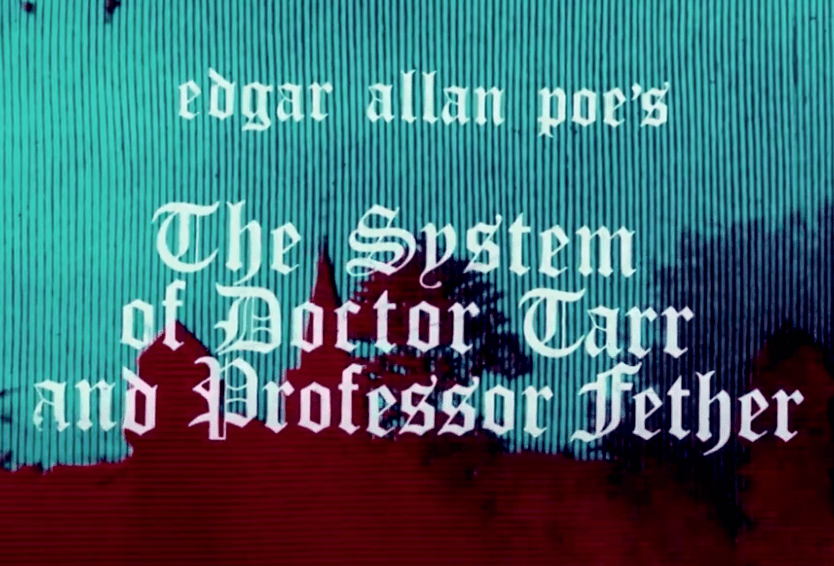
La mansion de la locura (1973) was a Mexican production; however, it was filmed in English, then dubbed into Spanish. This tells me that I picked the wrong version of the film to watch. Recently released on Blu-ray by Vinegar Syndrome, The Mansion of Madness is called Edgar Allan Poe’s The System of Doctor Tarr and Professor Fether in its opening titles. Like most foreign films, I chose the original language with English subtitles.
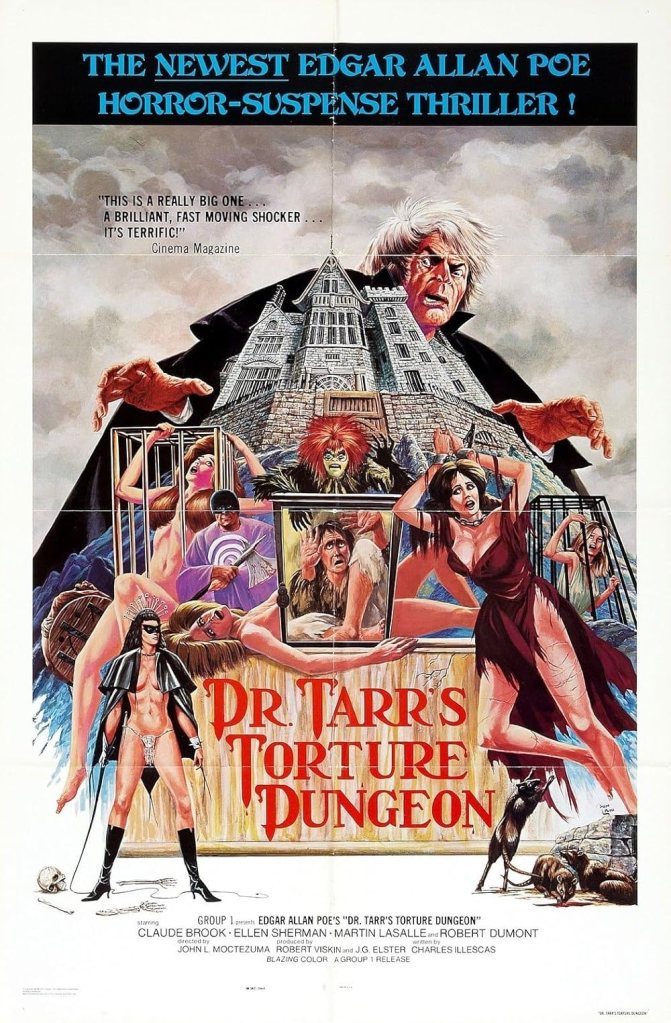
Therefore, I wasn’t watching the film in its original state. That would have been Dr. Tarr’s Torture Dungeon, an edited version released in the United States in 1976 by Group 1 International Distribution. The version I watched was nine minutes longer, making the length, not the language, the real reason I should have watched the original. I struggled with the pacing, especially at the beginning, and had to watch it in two sittings.
In the booklet accompanying the Blu-ray, Alessandra Moctezuma, the director’s daughter further explains the reason for the languages:
He had to make the movie inexpensively and, partly because of all his work obligations, he had to have it done in five weeks. He planned and estimated all the costs accurately. La Mansion was made for $100,000 (about the equivalent of $688,000 in 2023.) As director, Lopez Moctezuma prepared and supervised every detail.
He prided himself in gathering the best team of qualified technicians. Many of the actors were American and to make it accessible to an international audience it was filmed in English.
The pacing wasn’t the worst thing about it. It also tried to be humorous, and in the worst possible way: with zany, madcap music screaming at us that what we’re watching is supposed to be funny. This is a movie about the inmates of an asylum taking over and imprisoning the doctors and staff. Their costumed antics in the woods don’t need to be explained as comedy.
I haven’t read Poe’s source material, but this version sounds like it might be fairly faithful to it. The story has been adapted several times, sometimes in films or television shows that I didn’t realize shared the story, such as The Alfred Hitchcock Hour’s “A Home Away from Home” (1963), Don’t Look in the Basement (also 1973), and Stonehearst Asylum (2014.) It also evokes for me the wraparound story from Asylum (1972.)
The film came to be in the aftermath of a difficult period in the history of Mexico and upheaval all around the world. It was a period of activism and liberation with an ongoing questioning of the establishment and societal norms. The wave of change was evident in the arts, film and popular culture.
Living through these momentous times, Lopez Moctezuma envisioned the atmosphere of a 19th century asylum as a reflection, a mirror of human society as a whole, the dank dungeons in the castle represented a society perceived in all its horror, where authoritarian mad men rule and imprison those who are sane.
After moving to the United States as a child, Gaston LeBlanc (Arthur Hansel) returns to France as an adult to tour the sanatorium where his father had been committed. The head of the institution, Dr. Maillard (Claudio Brook), has supposedly developed a revolutionary new system for treating his patients: letting them roam freely. A gang of them dressed in military uniforms ambushes LeBlanc’s carriage and ties his friend, Julien Couvier (Martin LaSalle), upside down to a tree.
Later, as LeBlanc learns the deep, dark secrets of the sanatorium, Couvier manages to loosen himself from the tree, but spends the rest of the movie hopping through the woods as if he’s in a gunny sack race. If scenes like this were excised from the American version, I would have enjoyed the movie more. Otherwise, it’s not a terrible movie. In fact, the sets are remarkable…
The rooms, halls, and dungeon of the sanitarium are crowded with “stuff.” It looks like a bomb has hit, leaving overturned furniture and trash throughout. However, the rubbish has been used to create interesting and unusual structures. LeBlanc’s bedroom is filled with a web like substance that he’s able to craft into a rope to climb out of what soon becomes his prison. The patients are theatrical, looking like they’re performing on a vehicle out of Mad Max: Fury Road.
As someone trained in the visual arts, Lopez Moctezuma took special care in setting up each scene and he collaborated with artists Leonora Carrington and her son Gabriel Weiss Carrington, who shared his sensibilities.
Mexico City/Tenochtitlan, which had been colonized by the Spanish and then occupied by the French, offered up fantastic sites for filming that could impersonalte a European castle and its surroundings.
After the slow start, The Mansion of Madness gathers speed when we learn – SPOILER – that Dr. Maillard is really one of the patients, Raoul Fragonard. Also, the lovely Eugenie (Ellen Sherman) is the real Dr. Maillard’s daughter and LeBlanc, visibly smitten, helps her rescue him and stage a revolution of the imprisoned professionals. I didn’t think I enjoyed it much, but after reading more about it, at least I now respect it.




 Classic Horrors Club
Leave a comment