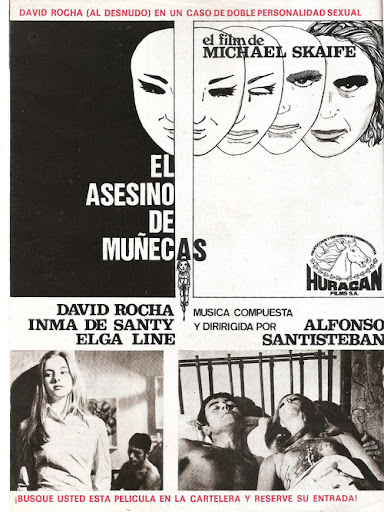
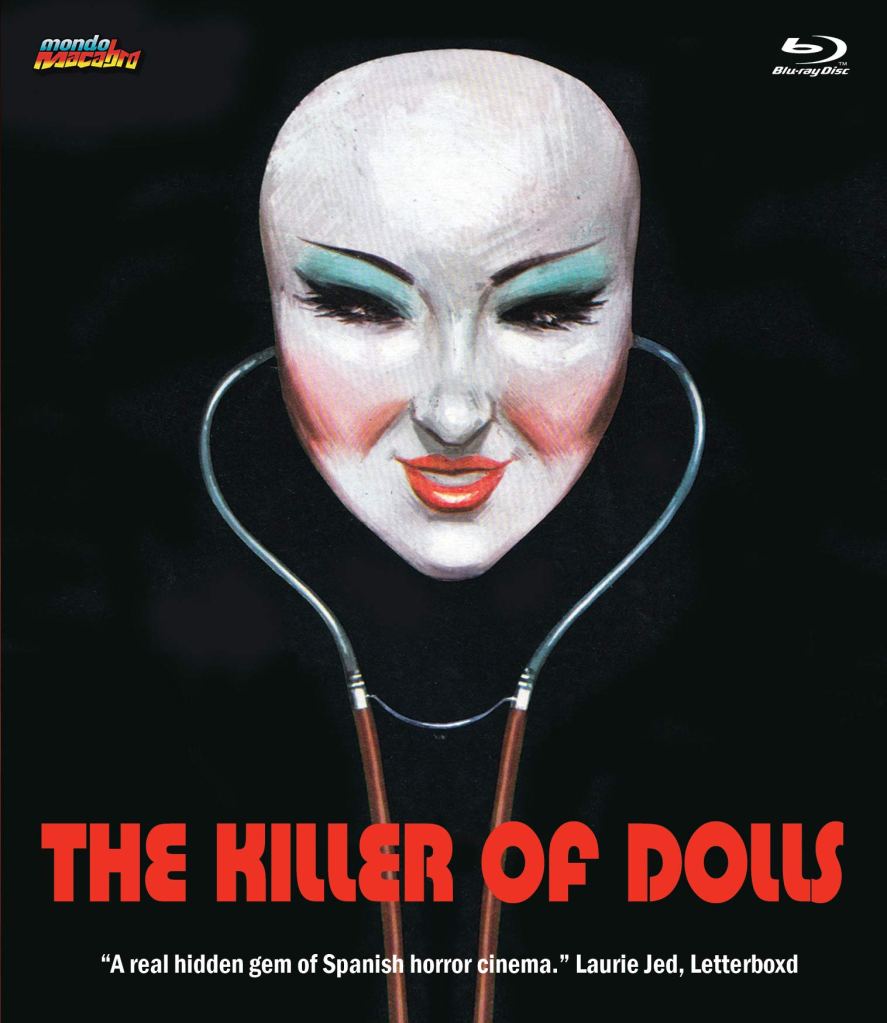
From the seed of an interesting idea grows The Killer of Dolls (1975), a movie as crazy as it is deranged. It comes from writer/director Michael Skaife, who failed to delight me with The Butcher of Binbrook (1971.) I can find little about this movie or its creator; however, simple IMDb research shows he made only six films in his career (unless you count five more in which he acted.) The last two were the “comedies,” Of Love & Death (1977) and Sins of a Nympho (1979.)
In The Killer of Dolls (1975), a young man named Paul (David Rocha) commits worse sins than making a movie that doesn’t entirely please me. It’s not a spoiler to tell you he dons a mask and wig and deals with anxiety by killing young women… or dolls. His victims aren’t necessarily figurative dolls, but perhaps literal, since he gets confused and often sees mannequins instead of the women they represent.
Paul is the son of the gardener at an estate who substitutes for his father when he takes a trip. Paul is available; he’s just been “chucked out” of medical school. However, he never loses sight of his desire to become a cardiovascular surgeon. Combining work with pleasure, he integrates his surgical skills into his modus operandi. Again, though, he’s never quite sure if he’s cutting into a woman or a mannequin and whether the shadow watching from behind a curtain belongs to a woman or a mannequin.
Neither is it a spoiler to tell you that Paul has a split personality… we’re told in the opening moments of the film this is what it’s about. For a while, we don’t know the details. We get one clue when a neighbor comments to Paul’s father that she thought he had a daughter. It must have been too difficult to sustain the mystery. Or, incorporating my New Year’s resolution to assume positive intent, maybe there wasn’t time in the production to pay much detail to the script.
Instead, Skaife bombards us with images that confuse us as well as Paul. They’re delivered in delicious 1970s style, but range from being nonsensical to incomprehensible. More positive intent: Skaife does a good job of sharing with us a little bit of what might be going on in Paul’s head. Rocha’s performance is unhinged, hardly ever buttoning his shirt, if he even wears one. He’s thin and lithe, flouncing across the screen.
Lest you think he’s gay when he rejects an older woman’s advances (Condesa Olivia, played by Helga Line), he falls in love with her daughter, Audrey (Imma de Santis.) Love is an emotion, too, so although he seems happy, it’s just as triggering for him as watching a bratty neighbor kid, Robert (Rafael ‘Indio’ Gonzalez Jr.) bash a doll against a brick wall. Maybe Audrey belongs with Paul; the fact that his bedroom has broken dolls hanging from the ceiling doesn’t scare her away.
After Paul and Audrey supposedly have relations, we have a long scene of Paul naked and taking a long shower, but Audrey stands in the bathroom fully clothed. Maybe Paul’s not gay, but I have to wonder about Skaife… not that there’s anything wrong with that, or that it even matters. Skaife and his camera love David Rocha. He’s clearly the focus and Line is portrayed as undesirable. On the other hand, maybe Skaife is an extremely talented director bringing the inner workings of Paul’s mind to life. Positive intent.



 Classic Horrors Club
Leave a comment