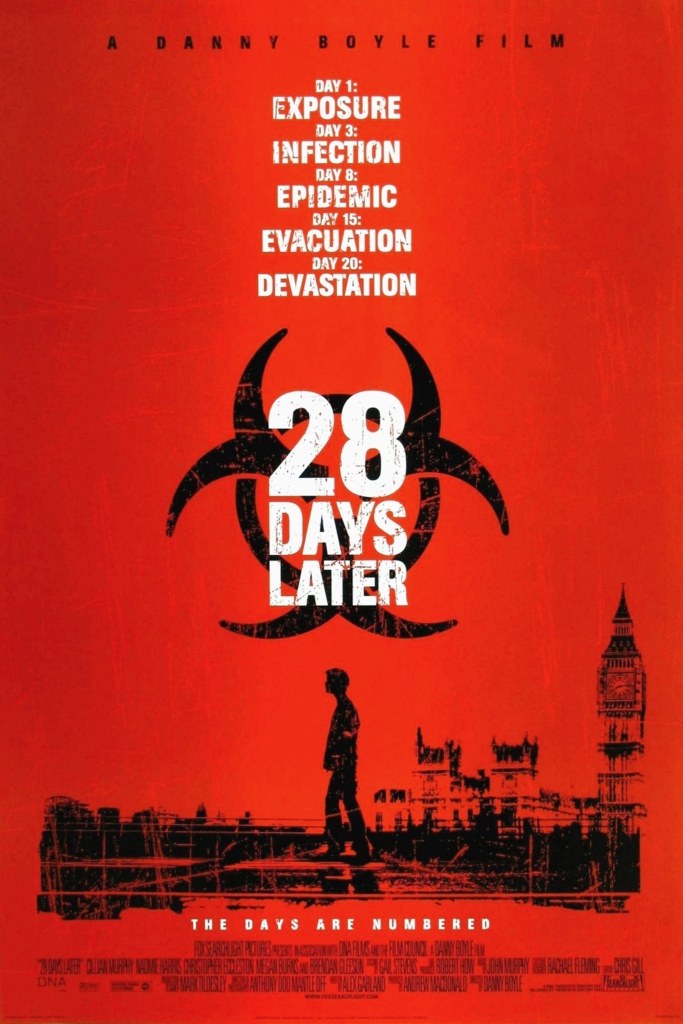
Despite it appearing on almost every list of zombie movies, I don’t consider 28 Days Later (2002) to be one of them. Sure, there are ferocious, zombie-like creatures, but they aren’t raised from the dead. They’ve been transformed by an equally ferocious virus. It’s about humankind’s reaction to the virus itself and whatever conditions it causes rather than the conditions themselves. Thus, you don’t hear about monsters on the street, you hear about “it,” the virus.
It started as rioting. And right from the beginning you knew this was different, because it was happening in small villages, market towns, and then, it wasn’t on the TV any more. It was in the street outside. It was coming through your windows. It was a virus, an infection. You didn’t need a doctor to tell you that. It was the blood. There was something in the blood. By the time they tried to evacuate the cities, it was already too late. The infection was everywhere. The Army blockades were overrun and that’s when the exodus started. The day before the TV and radio stopped broadcasting there were reports of infection in Paris and New York. We didn’t hear anything more after that.
We see what happened in the opening moments of the films, but Jim (Cillian Murphy) learns only after waking up from a coma in an empty London hospital. Phones are off the hook, the city is still, and trash litters the streets. As he wanders outside, there are dead bodies everywhere and he’s chased by some that aren’t quite dead. He’s saved by Mark (Noah Huntley) and Selena (Naomi Harris) when they toss fire bombs in their general direction.
Besides sharing the “bad news” with him, plus the fact that there’s no government, police or electricity, they teach him two lessons: never go anywhere alone and travel only in daylight. Jim’s first instinct is to find his family, but when he enters the apartment, the smell tells him it’s probably too late. He finds their bodies lying in bed with a note for him:
With endless love, we left you sleeping. Now we’re sleeping with you. Don’t wake up.
His traveling companions tell him they died peacefully and he should be grateful. What are these survivors to do when simply “staying alive is as good as it gets?” Keep moving. They encounter Frank (Brendan Gleeson) and his daughter, Hannah (Megan Burns) and eventually hear a recorded broadcast about a safe haven 27 miles northeast of Manchester.
They face terrifying obstacles on their way, especially going through a tunnel in Frank’s taxi, but nothing as unsettling as what they find in Major Henry West’s (Christopher Eccleston) camp in a country estate. Of course, it’s ultimately going to be humans that are more dangerous than the infected because they can’t blame being infected by a virus for performing despicable deeds. Jim and company are going to have to survive them.
28 Days Later was directed by Danny Boyle who hit the ground running with his first two theatrical motion pictures, Shallow Grave (1994) and Trainspotting (1996.) Six years and two movies later, he made this masterpiece. (His 2008 movie Slumdog Millionaire was an Oscar darling, winning eight awards, including Best Director and Best Movie.) He demonstrates a singular style here in one of the first films made digitally instead of with film.
It suits the story, with a sometimes grainy texture, as if the entire planet has been painted with a giant dingy brush. Long shots make the survivors look tiny, and extreme close-ups reflect the hysteria. Another distinctive sign of Boyle’s is the soundtrack. The music is by John Murphy, but includes appropriate pieces from elsewhere (and elsewhere) such as “In Paradisium,” a haunting melody evoking “Ave Maria.”
28 Days Later was not the first film to deal with an outbreak or contagion. We could credit none other than Vincent Price for The Last Man on Earth (1964.) And it certainly won’t be the last. Why, the same year this was released, we also saw Cabin Fever and Resident Evil. This stands above the others, though, which focus on the horror. 28 Days Later has plenty of that, as well, but definitely a lot more.

This movie discussion is part of
the annual #countdowntohalloween.
Visit countdowntohalloween.net for links
to other great blogs that are celebrating!
 Classic Horrors Club
Leave a comment