
It was thrilling for me to learn that I could watch an Alfred Hitchcock film as one of the movies for this year’s #countdowntohalloween. Number 17 (1932) was his 21st film and the last one he made for British International Pictures. While it was a disappointment, there’s some comfort knowing that the master himself thought it was terrible, a “very cheap melodrama.” But, man, can Hitchcock make a very cheap melodrama seem exciting at times!
The story takes place in an old dark house; however, its temporary inhabitants aren’t trying to steal money from a dying relative. Instead, they’ve already stolen the jewels and are gathering before making their escape… I think. It was a hard story for me to follow. With his thick accent I barely understood a word of one of the primary characters, Ben (Leon M. Lion.) He’s discovered lurking about inside by a man who calls himself, “Fordyce” (John Stuart.)
Soon they’re joined by a dead body and other characters falling through the roof. Yes, besides being a crime thriller, Number 17 is a comedy. The odd thing for me with this combination of genres is that I enjoyed the comedic parts. Lion is very good physically, and his banter with Fordyce seems like it would be funny from the bits and pieces I could interpret. Of course, now I remember none of these supposedly funny moments.
What I remember is, well, Hitchcock. He does a lot of interesting things with shadows and the moving camera… almost too many interesting things for a movie this slight. For all the good this does, though, the climax is counterintuitively squandered with what should depict the most suspense: a chase scene on a moving train. I was really confused by this with a real train alternating with a miniature, sometimes going opposite directions.
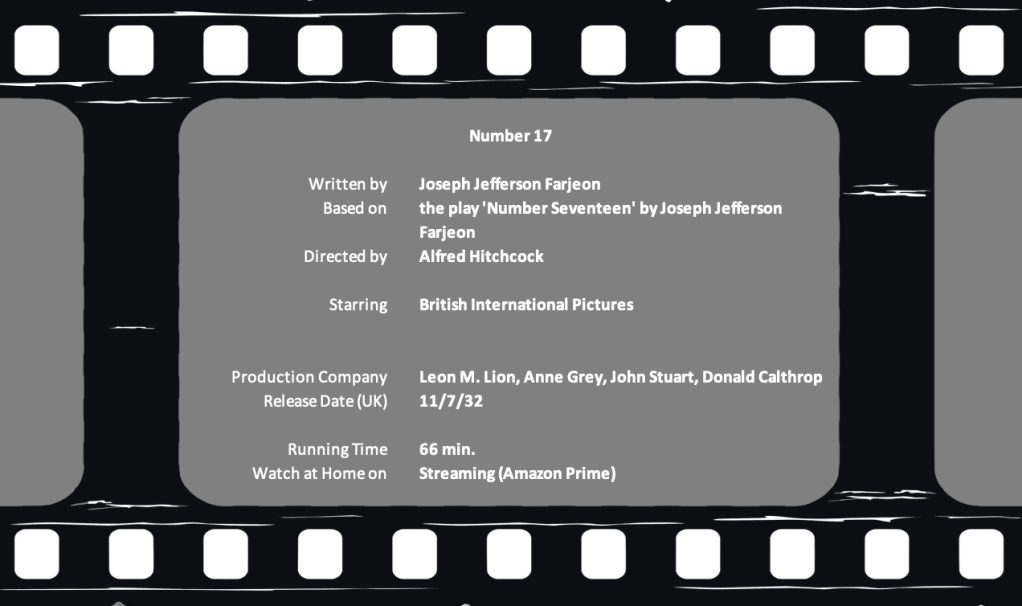
There is a cool crash at the end, though, as the train hits another one at full speed and knocks it into the ocean. Hitchcock could make some very long films, but none feel as long as this one, which runs only just over an hour. It was written by Joseph Jefferson Farjeon, who also wrote the play on which it was based, “Number Seventeen,” with the number spelled out. My final question is, “How did they do the train crash on stage?”


This movie discussion is part of
the annual #countdowntohalloween.
Visit countdowntohalloween.net for links
to other great blogs that are celebrating!
 Classic Horrors Club
Leave a comment