During the summer of 1983, I had the best time of my life. I was home from college following my sophomore year and had reconnected with a group of high school friends who were a year behind me. We loved movies and pop culture, so stood in line to see Return of the Jedi, made fun of the name, Octopussy, and to this day call the smallest, cutest dogs, Cujo.
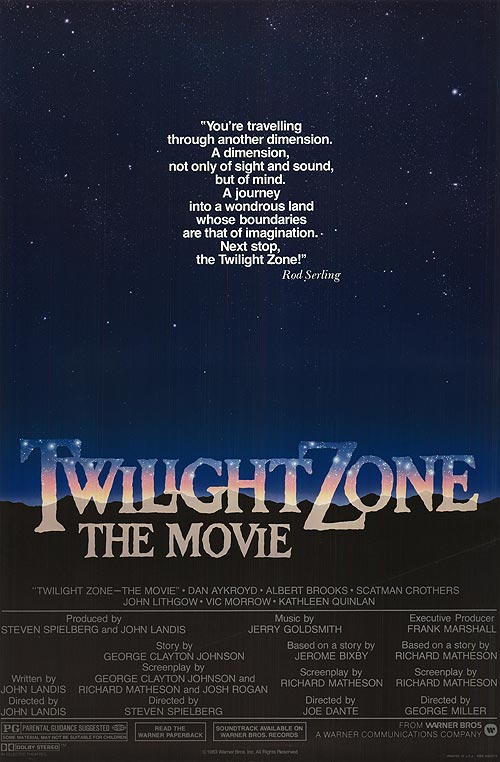
I’ll never forget after we saw Twilight Zone: the Movie and went to my friend, Cheryl’s, house, I uttered the words, “Steven Spielberg can do no wrong,” effectively jinxing my later viewings of Always (1989), Hook (1991), and The Lost World: Jurassic Park (1997) where Spielberg did very, very wrong. Regardless of everyone saying that the fourth segment of Twilight Zone: the Movie was the best, it was the second that I adored.
‘Kick the Can’ wrecked my emotionally. I was a sentimental kid easily manipulated by the story of residents of Sunnyvale Retirement Home who experience a night of being young again, then realize they like being their adult age after all. The joy in the music by Jerry Goldsmith heightened my feelings and director Spielberg worked his early filmmaking magic for one of the last times.
My second favorite was almost everyone else’s favorite, the final segment, ‘Nightmare at 20,000 Feet,’ directed by George Miller, who brought the wide open energy of Mad Max (1979) and The Road Warrior (1981) to the claustrophobic confines of a passenger plane. Arguably, the most horrific, and the only one with a real monster, it made me forget any previous segments that may have dragged just a bit.
Oddly, I never cared as much for the third segment, ‘It’s a Good Life,’ directed by Joe Dante. Maybe I never understood it. The zany products of young Anthony’s (Jeremy Licht) power to bring his thoughts to life seemed cartoonish and the story seemed out of place to me. I would have preferred to see a new version of ‘Time Enough at Last,” perhaps again featuring the actor who narrated Twilight Zone: the Movie, Burgess Meredith.
I was also in agreement with those who thought the weakest segment was the first. Directed by John Landis, ‘Time Out,’ was edited to remove scenes filmed when actor Vic Morrow was killed on set. I didn’t think it was awful, but there was a sadness that hung over it and started the film on a low note.
Well, the film actually started with a road trip as Albert Brooks and Dan Aykroyd try to entertain each other on an isolated highway when they lose their radio signal. The short introduction ended with Aykroyd saying the oft-repeated line, “Do you want to see something really scary?” Following the jolt it delivers, the camera tilts to the sky and we saw a really cool update of the television series opening.
I had not seen Twilight Zone: the Movie in a long, long time, but, of course, I owned it. Until a few days ago, everything I just wrote is what I would have told you I thought about the movie. What do I think about it now?
The introduction felt slow to me. Of course, I knew what was coming and was anticipating it, but it seemed like it took too long to get there. Perhaps I don’t enjoy the humor expressed by the two actors as much today as I did then.
‘Time Out’ is still the weakest, but is probably the best morality tale of the bunch. Morrow is a bitter racist who gets to experience the opposite end of his hatred after saying words that we can no longer say in 2024. It ended abruptly and I still felt the sadness of the actor’s death.
I wasn’t quite as enamored by ‘Kick the Can.’ The focus of my sentimentality shifted to the one man who poo-pooed the idea of being young again, finally asking if he could join the others when it was too late. The music didn’t seem as majestic and it all seemed less natural to me. Don’t get me wrong; I still adore it!
The biggest shift in memory came from ‘It’s a Good Life.’ First, in the day and age of CGI, the practical effects used to bring Antony’s creations to life are brilliant! Second, the mystery of the people that live with Anthony and the world he has created intrigued me more and the secrets were more satisfying. (I still find the ending a little weak, though.)
‘Nightmare at 20,000 Feet’ remains a tour de force, not just for its director, but for its star, John Lithgow. I had forgotten how manic he is about flying before he sees a gremlin on the airplane wing. The one scene I will now remember is after he sees it the first time and shuts the window screen, then can no longer bear not looking, he opens it and the monster’s face is right in front of him.
As a single film, I love Twilight Zone: the Movie. Its stronger and weaker parts somehow fit together to make it an effective overall effort. Today, I suppose it’s like watching a mini-marathon of the best of the television show. (Only ‘Time Out’ was not based on an original episode.) I’m fond of this movie, both in my memories of the best summer of my life, and in my ability to revisit it and enjoy it in different ways.


 Classic Horrors Club
Leave a comment