
Of the four segments in Cake of Blood (1971) aka Pastel de Sangre, my favorite is the second, ‘Victor Frankenstein’. As the title indicates, the character is a familiar one, but this Frankenstein (Angel Carmona Ristol) isn’t your ordinary monster-maker, and El monstrou (Eusebio Poncela) is even more unique. First of all, this isn’t a creation story. In fact, Victor narrates nearly the entire novel in the first couple of minutes of the movie.
What remains is the story of what’s happening at home while Victor is away with his creation. Henry Clerval (Jaime Chavarri) and Justine (Chart Lopez) have the hots for each other and spend nearly all of their scenes in bed or frolicking outside. Elizabeth sits on the front porch growing old. When Victor does return home and his mother’s dying wish is for him and Elizabeth to be married, he agrees. However, he watches through a peephole as Henry and Justine prepare to bathe.
Victor then leaves again, telling Elizabeth that he’s going to send a man and when he arrives she must welcome him and treat him just like she treats him. Hmmm… what does that mean? I don’t think Victor is too fond of his home or his friends because he tells El monstruo to descend upon that place and destroy it… throttle necks and tear off limbs.
That hardly seems possible for this particular monster. He’s thin and gangly, barely able to walk a straight line. But he’s handsome, and when he stumbles upon Henry and Justine (you guessed it, frolicking), Justine realizes that he copies everything he sees and begins undressing Henry to initiate a three-way. El monstruo gets rough, though, and the young lovers are soon dead by rock to the head.
I won’t say anymore, but there are some additional twists and turns to the tale that I didn’t see coming. Obviously, there’s a layer of sex embellishing the story, just as there is in the others, which are all kind of sexy in their own ways.
Cake of Blood opens with ‘Tarota’ (‘Tarot’), a haunting story of a man who’s… well, haunted. He’s a lonely knight traveling the countryside during an epidemic when he stumbles upon a beautiful woman lying on a stone slab inside a crumbling castle. He befriends a strange boy and as their journey continues, the knight can’t stop thinking about the woman.
He returns to the castle, stands over her body, sheds a tear and says, “I know you’re going to wake up,” then he leaves again. She does wake up and she follows him. She’s suddenly in front of him on the beach and when he removes his shirt and walks toward her, they share a passionate embrace. She then slices open his chest with a sharp fingernail.
There’s a surreal conclusion to this segment, but all the segments are surreal. For example, during the third, ‘Terror entre cristianos’ (Terror Among Christians), we travel with two men, a soldier and a politician, as they flee persecution by the Romans. There’s the vague explanation of trees in the forest that seep a red liquid and something about ghostly children, but they must go by the forest in order to escape.
They make camp and the politician goes to sleep while the soldier… goes into the woods! What happens next may be a dream, it may be real, or it may be a little of both. It’s creepy, though, no matter how you interpret it.
Finally, we enter modern day with ‘La Danza o las supervivencias afectivas’ (‘The Dance, or Emotional Survivals’), the most straightforward of the segments. It reminds me of an episode of Night Gallery. A man watches a pretty young woman through a telescope when a sharply-dressed man approaches from behind. He tells the man that the woman is alone and has a house full of treasures they could steal.
They break in and the sharply-dressed man tells the telescope man to bind and gag her in the basement while he searches upstairs. What happens next isn’t all that straightforward, I guess, but reality is mixed with fantasy until the locked door of a room upstairs is opened and all hell breaks loose.
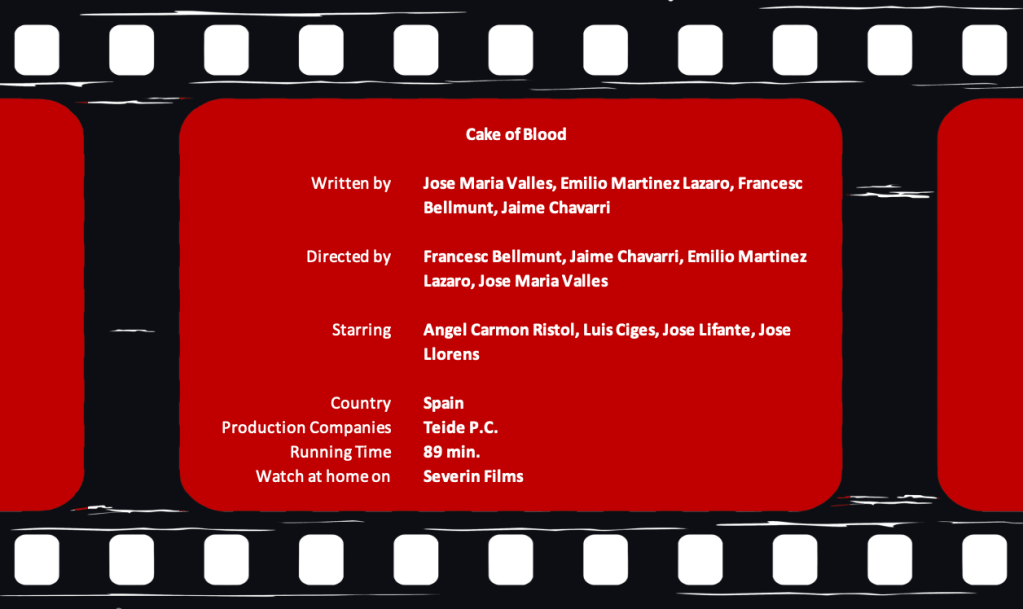
I can find no information about Cake of Blood; I need to see what special features are on the Severin Films Blu-ray. I just know it’s an anthology with chapters that takes place during four different historic periods, written and directed by four different people: Francesca Bellmunt, Jaime Chavarri, Emilio Martinez Lazaro, and Jose Maria Valles. I really it. I may not have understood everything, but neither do I fully understand my dreams.

 Classic Horrors Club
Leave a comment