
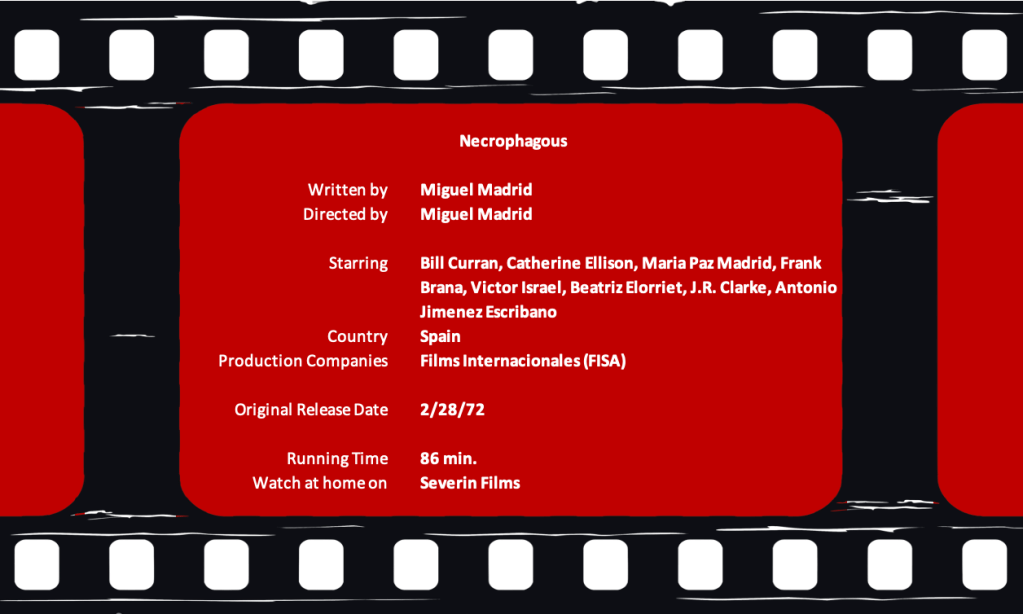
At one point during Necrophagous (1971), I considered shipping the blu-ray back to Severin Films with a note that the chapters were out of order. For nearly the first hour, I was completely confused about who the characters were and what the heck was happening. Shifting blame from Severin to the film’s editor, Maria Luisa Soriano, I envisioned attempting to piece together a coherent plot after rolls of film spilled onto the floor.
Luckily, at 50:00, Inspector Harrison (J.R. Clarke), stopped the “action” by saying, “Summing up…” I’m going to share what he said after that because I truly believe if I had understood, I may have enjoyed the film more than I did:
…we have a doctor suddenly becoming very rich, Elizabeth Sherrington’s head found outside her tomb, and a scientist who disappears at the height of his career. What’s certain, someone is taking corpses from their graves.
Harrison speaks of Dr. Lexter (Frank Brand), who has infiltrated the wealthy Sherrington Family for (at this point) unknown reasons. We know he’s the bad guy, though, because every time he appears, a sudden musical stinger knocked me out of my chair. Michael Sherrington (Bill Curran) is Elizabeth’s (Senny Green) husband, who returns from the road to learn that she died during childbirth. While investigating the true cause of her death, Michael discovers not only is her grave empty, but so is every other grave in the cemetery. Also, his brother, Sir Robert (John Clark) has disappeared.
In retrospect, Harrison’s recap helped me reflect and understand the first 50 minutes of the movie a little better. However, I still wasn’t sure what was happening from that point onward. Thankfully, Harrison provides another summary:
And now there’s some people around here I’ve never seen before. Who was here when your young niece Margaret swore that she saw Michael? Couldn’t have been him. Why did Dr. Kinberg want to speak to him in private? And who is this very mysterious assistant at his clinic? Who calls himself Harrison. The Earl of Binbrook will never come back to life.
Apparently, the other characters think that Michael is dead. I missed that plot point. One minute he’s digging up graves, the next he’s in the hospital suffering from “terror induced by shock.” I guess being locked in the dungeon with a breathing mound of dirt on the stone floor is scary. Two hands plunged upward from the mound and we see a close-up of the eyes of some kind of monster. I guess the summary didn’t help much, after all. I don’t recall Dr. Kinberg (Antonio Jimenez Escribano) wanting to speak to Michael in private. I don’t know about a mysterious assistant. And I thought Harrison was a police inspector. See, it’s confusing!
In the likelihood that you’re smarter than I am, I won’t share the closing monologue from Sir Robert that explains the entire movie. It seems that writer-director Miguel Madrid also knew it was going to be confusing. Perhaps if you disregard the storytelling, there are some creepy moments. There are masked and robed figures running around the cemetery. (I still don’t know who they were and why they’re running around the cemetery.) And there’s a monster, most effective with the close-ups of the eyes, less so with the full shot of its green face with little twigs sprouting from his head here and there.
Just the other day, I had a conversation with a co-worker who likes to read the last chapter of a book first. I scolded her for that, but after watching Necrophagous (aka The Buthcher of Binbrook and Graveyard of Horror), I think for once I’d recommend watching the end, then going back to the beginning to look for clues, not about the mystery itself, but about how they can be connected to create some coherence.
 Classic Horrors Club
Leave a comment