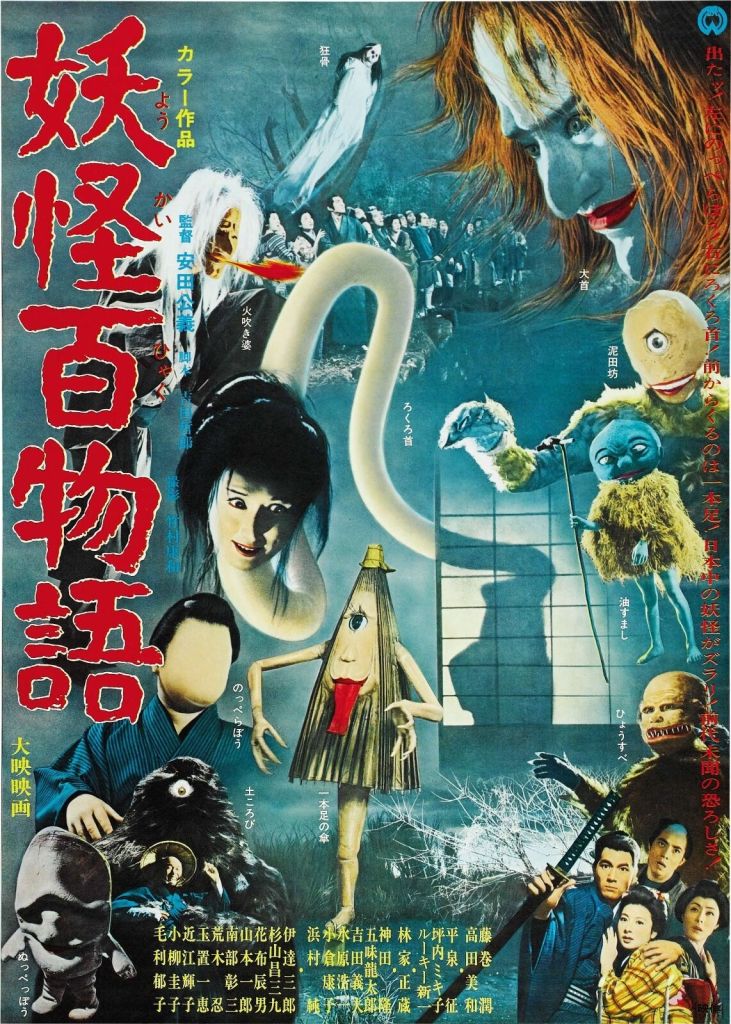
Before I watched Yokai Monsters: 100 Monsters (1968), I had no idea what a “Yokai monster” was. After watching a handful of experts discuss it for 40 minutes on the Arrow Video Blu-ray special feature, Hiding in Plan Sight: A Brief History of Yokai, I learned that the term can mean many things. I’m not the person to be formally educating others, however…
The simplest explanation seems to be that Yokai are Japanese monsters. They are not Kaiju, though, because they aren’t giant monsters. Plus, Yokai like Kappa originate from folklore, whereas Kaiju like Godzilla originate from science. Also, Yokai are usually kid-friendly, more mischievous than scary, which makes me think of an Americanized version: Pokemon.
For me, 100 Monsters has plenty of thrills and chills. It depicts a Japanese tradition called, “The 100 Stories.” A group of people take turns telling a scary story. At the end, their candle goes out. After the final story, the participants conduct a ritual to prevent being cursed. Before the opening credits, we see and hear one of the stories, not realizing yet that it’s not specifically related to the overall plot.
However, another story will be incorporated into the plot when a magistrate who’s going to tear down a shrine to replace it with a brothel hosts a gathering of his cronies. At the end of the 100th story, though, he says they need no ritual. He has his own good luck charm to use against the curse… money. Straying from the proper custom, these men will be haunted by monsters that come to life… or that they believe come to life.
My favorite is Rokurokubi, the long-necked woman. She’s the star of the story told at the gathering, but can also be spotted elsewhere. When a woman prepares fish her husband retrieved from a forbidden lake, she can’t scrub the blood off her fingers. Then, her neck grows, eventually long enough to wrap around her husband. The special effects are terrific! After a brief first glimpse, we then see only the shadow behind a translucent panel. Then, her face jerks around the corner.
The strangest is Kasa-Obake, the umbrella boy. It seems that some Yokai are everyday objects that have taken sentient form. The magistrate’s son is mentally challenged and no one believes him when his drawings come to life. Then, one of them materializes to become his friend, occasionally licking his face with its long tongue. Kasa-Obake is more of a puppet than a special effect, but it still looks good.
When all the evildoers have been dispatched, all Yokai (I assume 100) parade through the village gates in slow motion and disappear into the sunset. They dance and swing their arms, unlike any creatures that you’d think would kill their victims in the sometimes grisly ways they do. You see Rokurokubi and Kara-Obaka and a menagerie of others that I imagine we’ll see in the two sequels that we’ll discuss during the month of May.
I understand we’ll experience different tones in the series, especially in the next one, Yokai Monsters: Spook Warfare. This one may be the most horrific we get. If they can maintain the quality, though, and tell a good story, I look forward to watching them and am sure I will enjoy them… that is, if I don’t turn into Nipper-bo, a Yokai that’s human looking, but has no face.


 Classic Horrors Club
Leave a comment