Disaster Film Checklist
- All-Star Cast (Oscar Winner):
- Ray Milland
- Cast (Others):
- Dennis Cole
- Susan Sullivan
- Leslie Nielsen
- Julie Sommars
- Sheila Larken
- Lonny Chapman
- James Olson
- Multiple Live in Danger from a:
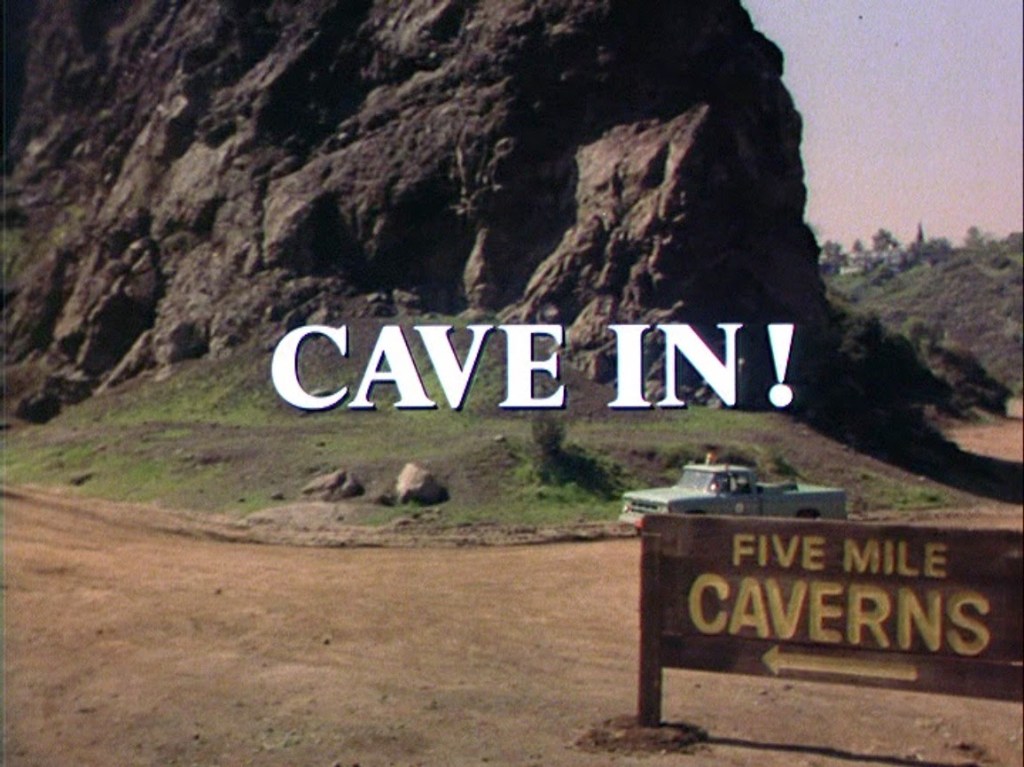
- Cave in at Five Mile Caverns
- Warnings are Disbelieved:
- Ranger Gene Pearson tells his boss, Walt Charles, that they should cancel tours of the caverns. Walt disagrees, “Look, Gene, it’ll be OK.”
- Death of Someone Who Deserves It:
- Tom Arlen, a gun-toting fugitive, tries to take a hostage just before the survivors emerge into daylight. For his trouble, Joe Johnson throws dirt in his face and wrestles him, resulting in an accidental shooting and tumble over the edge of a cliff wall. Several seconds later, we hear a splash.
- A Daring Rescue:
- While crossing a rickety bridge, Senator Kate Lassiter slips and hangs from it. Ranger Gene Pearson slowly walks onto the bridge to save her.
- Character Relationships:
- Ranger Gene Pearson was engaged to Senator Kate Lassiter until their careers drove them apart.
- Joe Johnson is still shellshocked about the loss of his partner after he’s blamed for causing it.
- Prof. Harrison Soames is a grumpy old man who’s hiding love letters from his daughter, Ann Soames. Meanwhile, he tries to convince her that he’s abandoned her.
- Theme:
- Redemption
Thoughts
If When Time Ran Out… was a whimpering last hurrah for theatrical disaster films of the 1970s, then that’s the purpose Cave In! serves for television. It’s a watered-down version of earlier “hits” like Flood, Fire, and Hanging by a Thread, and concludes the third part of a thematic trilogy with Hanging by a Thread and The Night the Bridge Fell Down.
In fact, the pattern from which Hanging, Bridge, and Cave In! were made is similar: a group of connected people is thrown into disaster during which flashbacks reveal the experiences that brought them together. The main difference is that while Hanging and Bridge were two-part epics, Cave In blessedly clocks in at just over 90 minutes.
To be honest, I don’t recommend watching as many disaster movies as I have this month in such a short time period. While moments shined, as a whole, most movies grew increasingly tarnished. The structure of this series was the tropes that all the movies share, but I didn’t anticipate the sameness that would outweigh the novelty.
Cave In! was made in 1979, but not televised until 1983. It seems like NBC was aware of the waning subgenre, but had overeagerly committed to it before the light bulb turned on. I’m guessing they had a contract with Irwin Allen and had to meet its obligations. I don’t want to accuse Cave In! of being a half-hearted attempt, but the world changed and the movies didn’t.
Even the “all-star cast” shines less bright. Ray Milland cements his position as the cranky old man of 1970s genre film, following roles in Frogs, The Thing with Two Heads, and others. He’s the least sympathetic in this one, though. Because there’s no flashback to adequately explain why he’d deprive his daughter of a happy life, we have to rely on shallow stereotype.
Other than Milland, there are no winners of major awards and no Hollywood royalty appearing to collect a paycheck. One of the pleasures of even When Time Ran Out… was that Paul Newman was in it. No matter how bad… Paul Newman was in it!
It’s ironic that the actor who comes closest is Leslie Nielsen. When he made Cave In!, Airplane! (1980) was a twinkle in the eye of Jim Abrahams and the Zucker brothers. However, when Cave In! was released, the disaster film had already become parody. Nielsen carries the weight of the drama in Cave-In!, but it’s hard to take him seriously. Look at the featured image of this post, even he looks glum about the entire affair.
This discussion has become less a review of one specific film than it has a reflection of many, but what else is there to say about a movie we’ve seen at least a dozen times before? The disaster subgenre may have outworn its welcome, but with the advent of CGI, there was a resurgence, with death and destruction at a level Irwin Allen could only have imagined.
People love to see the spectacle, but is that enough? A good disaster film must also have sympathetic characters. (If we’ve forgotten that fundamental truth, Godzilla Minus One reminds us of it.) There needs to be something new added to a genre to keep it relative. Looking back, that’s where Hollywood failed. But is was sure fun while it lasted!

 Classic Horrors Club
Leave a comment