Welcome to “Disaster December!” Starting later today, and throughout the month, all our movie discussions will pertain to 1970s disaster films, both theatrical releases and TV movies. Follow along on Facebook, Instagram, Twitter, and YouTube for fun facts and history, and be sure to listen to this month’s episode of The Classic Horrors Club Podcast where Richard Chamberlain and I will discuss two 1970s blockbusters: The Hindenburg (1975) and Black Sunday (1977.)
Definition
Few other subgenres have as many consistently used tropes as the disaster film, which makes the requirements for belonging to this category easy to define. For this particular series, there are 57 movies (both theatrical and TV) that I consider to belong to the subgenre. To a large extent, they feature:
- An all-star cast:
- Probable on-screen appearances of Henry Fonda, Ava Gardner, Charlton Heston, George Kennedy, Leslie Nielsen, William Shatner, and/or Shelley Winters
- Likely behind the scenes presence of producer Irwin Allen or director Jerry Jameson
- Multiple lives in danger from a…
- Threat beyond their control for which…
- Warnings are disbelieved or ignored and there’s a…
- Difference in opinion about how to proceed leading to a…
- Dramatic confrontation between two characters that results in the…
- Death of the someone who deserves it or…
- A brave sacrifice from someone who doesn’t deserve it.
- Survival of babies and/or pets
- Violation of laws of physics requiring suspension of disbelief
- Daring rescue(s)
- Characters experiencing or suffering from:
- Broken relationships
- Reconciliations
- Physical (or mental) handicaps
- Phobias
- Themes such as:
- Redemption
- Complacency
- Corporate greed
- Power of nature
- Science & technology
In some of the most ambitious disaster films:
- Impending doom is not prevented and…
- A visually spectacular tragedy occurs, requiring that…
- The characters must work together to survive the aftermath.
- Efforts to stop the disaster create a second one
History
Disaster films are not restricted to the 1970s. In fact, they’ve been around for as long as motion pictures have existed. While this is an era I want to explore in the future, this “history” is going to start with the first disaster film of the 70s, one that was released on March 5, 1970 by Universal Pictures: Airport, which includes a bomber on board and an airport that may be closed due to weather conditions. Threats to airplanes and their passengers will become the most common plots of the 57 movies with which we’re dealing.
As you’ll see all month, television was quick to jump on the disaster film bandwagon, sometimes with knock-offs and sometimes with improvements. The first 70s TV disaster movie aired on September 17, 1971 on CBS: Terror in the Sky. It also featured an airplane in danger and, when the crew suffers from food poisoning, used the trope of someone other than the pilot flying the plane.
Metro-Goldwyn-Mayer released their only disaster film of the 70s on May 24, 1972, and it was about… a threat to an airplane and its passengers: Skyjacked. If you think only television “borrowed” material from theatrical releases, Hollywood studios did as well. Like Airport, there was a bomber on board in Skyjacked.
You may be surprised to learn that two years before Earthquake shook the box office, television gave us the first 70s disaster film dealing with an earthquake. On October 24, 1972, ABC aired Short Walk to Daylight about a disparate group of people trapped in a New York City subway after an earthquake.
Then came The Poseidon Adventure on December 13, 1972 from Twentieth Century Fox. This and The Towering Inferno (1974) were the only two disaster films of the 70s from Fox, which is funny because they’re generally known as two of the best. Richard and I talk extensively about both these films on episodes 54 and 76 of The Classic Horrors Club podcast.
Here we approach the four-year period with the most disaster films: 1974-1978. Six more aired on television before the next theatrical release:
- Runaway (Sept., 1973, ABC) Runaway train
- …and Millions Die (Nov. 13, 1973, CBS) Lethal gas
- Heatwave! (Jan. 26, 1974, ABC) Heatwave
- Hurricane (Sept. 10, 1974, ABC) Hurricane
- Terror on the 40th Floor (Sept. 17, 1974, NBC) Fire (three months before The Towering Inferno)
- The Day the Earth Moved (Sept. 18, 1974, ABC) Earthquake
The next theatrical release was on Sept. 25, 1974 from United Artists. Like the last theatrical release, Juggernaut took place on a ship. However, it didn’t capsize; it was loaded with bombs.
One television movie preceded a flurry of theatrical releases: Where Have All the People Gone?, which aired on NBC on Oct. 8, 1974. It dealt more with the aftermath of an apocalyptic event caused by a solar flare.
Now, here we go…
- Gold (Oct. 16, 1974, Allied Artists Pictures) Mine
- Airport ’75 (Oct. 18, 1974, Universal Pictures) Private plane hits passenger plane
- Earthquake (Nov. 15, 1974, Universal Pictures) In Sensurround!
- The Towering Inferno (Dec. 16, 1974, Twentieth Century Fox) Fire
- The Hindenburg (Dec. 25, 1975, Universal Pictures) Historical disaster
Then, through the end of 1976, we saw:
- Perilous Voyage (July 29, 1976, NBC) Ship
- Survive! (Aug, 4, 1976, Paramount Pictures) Airplane crash
- Mayday at 40,000 Feet (Nov. 12, 1976, CBS) Airplane
- Savage Bees (Nov. 22, 1976, NBC) Bees
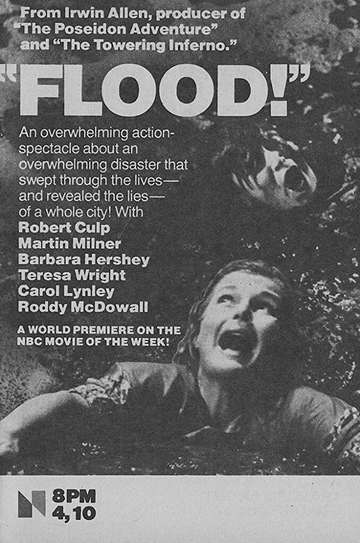
Finally, on November 24, 1976, NBC aired the first of Irwin Allen’s television disaster movies, Flood…
Irwin Allen
For many, producer Irwin Allen is known for his 1970s disaster films. However, he had been a master of the adventure/fantasy spectacle for nearly twenty years before The Poseidon Adventure (1972) became a huge hit at the box office. These films included The Animal World (1956), The Lost World (1960), Voyage to the Bottom of the Sea (1961), and Five Weeks in a Balloon (1962.)
He’s the perfect creator to feature in this series because he crossed over from theatrical releases to television series such as The Time Tunnel (1966-67), Lost in Space (1965-68), Voyage to the Bottom of the Sea (1964-68), and Land of the Giants (1968-70.) Then, in the 70s, he produced as many disaster films for the small screen as he did for the big screen.
In September of 2023, Shout Factory released a wondrous Blu-ray box set called Irwin Allen: Master of Disaster containing two of his theatrical releases and five of his television productions. With the exception of The Swarm (1978), I watched all the movies we’ll discuss this month on Blu.
Come back later today as we discuss Flood…
Resources
Art
© <a href=’https://www.123rf.com/profile_imagehitasia’>imagehitasia</a>, <a href=’https://www.123rf.com/free-images/’>123RF Free Images</a>
© <a href=’https://www.123rf.com/profile_imagehitasia’>imagehitasia</a>, <a href=’https://www.123rf.com/free-images/’>123RF Free Images</a>
<a href=”https://lovepik.com/images/png-cartoon-fire-background.html”>Cartoon Fire Background Png vectors by Lovepik.com</a>
https://www.rawpixel.com/image/12650989
Books
Annan, David
Catastrophe: The End of Cinema?
Lorrimer Publishing Ltd.
1975
Kay, Glenn, and Michael Rose
Disaster Movies
Oakville ON, Mosaic Press
2006
Hogan, Ron
The Stewardess is Flying the Plane!: American Films of the 1970s
New York, Bulfinch Press
2005
Websites
 Classic Horrors Club
Leave a comment