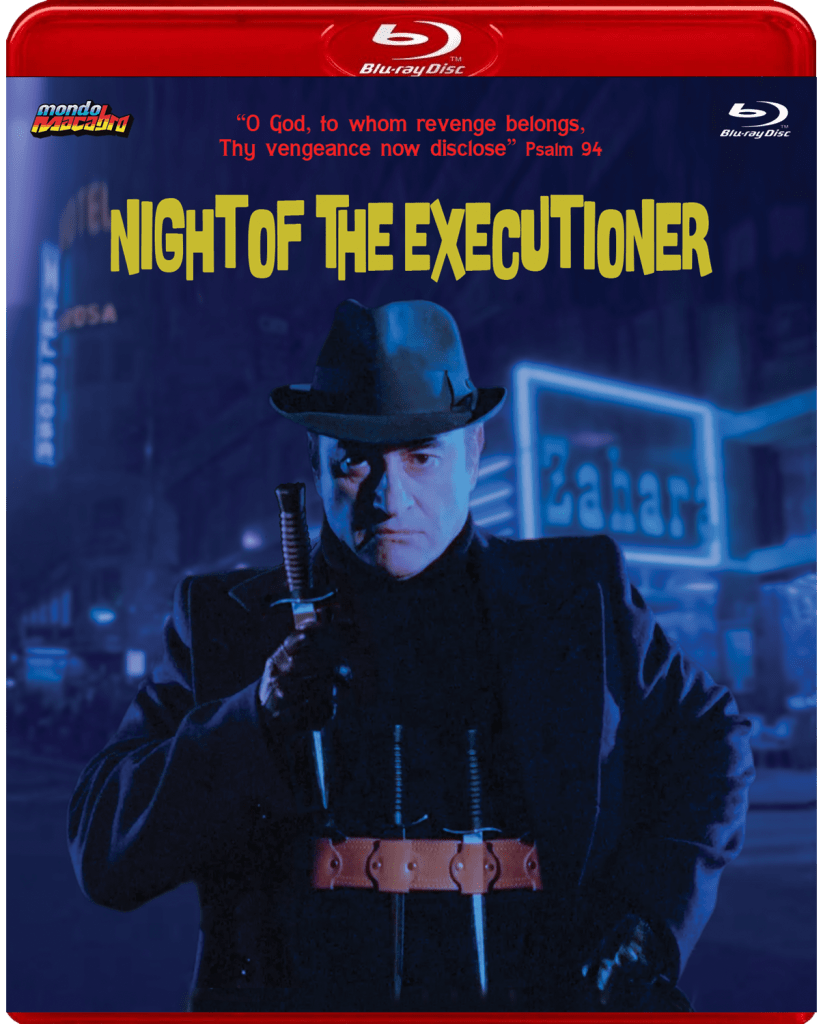
For the first time (and 30 years into his career) we hear Paul Naschy’s real voice in Night of the Executioner (1992.) Prior to this, he was always dubbed by another actor. It’s ironic, then, that for most of the movie, he doesn’t talk! That happens when thugs invade your home and cut out your tongue. You survive, but “will never speak again.”
The day started so well for Dr. Hugo Arranz (Naschy.) He went shopping with his lovely wife and daughter. Sure, afterwards, some punk harassed him and took all his cash, but who would have thought this punk worked for a crime syndicate and would rally his colleagues to interrupt Hugo’s birthday dinner to take more?
Watching the joyful opening, yet aware in broad strokes what was going to happen, Hugo struck me as a Bruce Wayne type. His family is murdered in his home instead of an alley in Gotham City, but he still goes through an exercise montage then dons a chest-high holster of knives and turns vigilante to get his revenge.
In spite of repeated warnings from his doctors that Hugo will “psychologically never be the same,” he’s calm, cool, and collected as he hunts and executes not only the specific thugs, but the entire crime syndicate. Much of his prep (except for the exercise montage) is unseen, but he gets most of his intel from a madam, Mati (Paloma Cela.)
Two women in his life represent the pros and cons of such an approach toward resolution. Olga (Luciana Wolf) is the angel on one shoulder, campaigning for improved prison conditions. Elvira (Adriana Vega) is the devil on the other shoulder witnessing his actions and helping keep his secret.
However, when Olga becomes a victim of the same thugs, she changes her tune. Meanwhile, Hugo has retreated to his Batcave, a farm in the country, with a third woman, Gloria (Angela Bravo), one of Mati’s prostitutes. She had been in a relationship with one of the thugs and fears for her life.
At the farm are two characters who, come to think of it, I can’t identify in Hugo’s extended family tree: housekeeper Rosa (Loreto Valverde) and a young boy (Nachy’s son, Sergio Molina.) They’re really there for the bad guy body count… people for the bad guys to keep killing, which fuels Hugo’s anger.
Yet Hugo doesn’t express much anger. Mouth shut while he jumps on top of cars and throws knives or fires pistols, emotion is seen only through his eyes. It’s not necessarily a showy performance from Naschy, though. You might consider it underplayed, but I liked his determination and devotion to the job.
Only one time does Hugo engage with a thug in hand-to-hand combat. It seemed odd that he wouldn’t kill him right away, but I’m going to insert a layer that may not have been intended. I think a part of Hugo realized his approach was wrong, so he wanted a little punishment for himself to maintain his humanity.
Night of the Executioner is sometimes hard to watch, especially in the beginning. It’s never as rough as that except Hugo continues to experience flashbacks and we’re subjected to the horror again and again. I’m not sure how I feel about it overall, but I can say that I liked it more than last week’s film, Howl of the Devil.


 Classic Horrors Club
Leave a comment