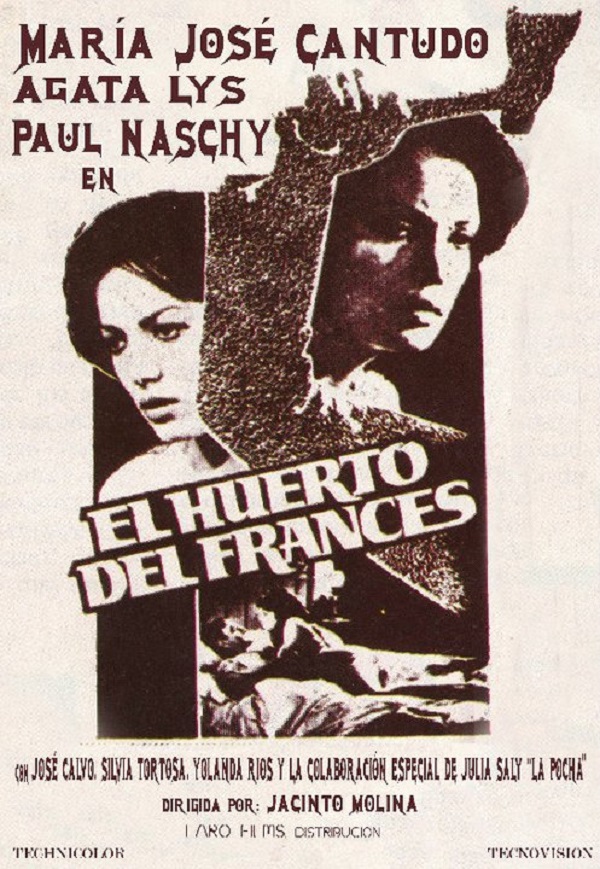
From his long list of films, Paul Naschy once said that The Frenchman’s Garden (1978) was his favorite. It’s not mine, but I can tell you from the way it quietly sneaked up on me, slowly dropped clues about what was happening, and built to a powerful conclusion, it’s one of his best. There’s a characteristic about it that I’m not going to share. It’s not strictly a spoiler, but learning it after fact caused me to reflect more heavily on the movie and appreciate it even more.
Most of the story is told through an extended flashback, with bookends taking place in what we suspect to be, then later learn is in fact, a prison. Inside the stark structure dropped in the middle of the scenic Spanish countryside, two men approach what’s coming next in different ways. Jose Munoz Lopera (Jose Calvo) wears fear on his face as he sits quietly with a priest. Juan Andres Aldije (Paul Naschy) cheerfully devours his last meal as if he’s the one who’s prepared it for the two guards that sit with him.
We assume they’re about to be executed, then spend the next 90 minutes or so discovering why. We learn that Juan is in some form a crime lord, operating from an establishment that draws rich men from across the country for a little gambling and a little fun with the ladies. Behind it lies his “garden” where, instead of planting flowers, he plants dead bodies. Jose is his reluctant accomplice, helping him lure the rich men, then killing them to steal whatever fortunes they carry with them.
Juan is one of those characters that lives by high moral standards even as he commits his crimes. For example, he doesn’t allow intoxicated men to harass his women, yet turns on those women when they become “ill” and can no longer work. They’re like cattle; he needs to take care of them because they’re his livelihood, yet he’ll put them down if they cease to be of value. He’s also faithful to his loving wife… when he’s not sleeping with other women.
One such dalliance comes to haunt him as Andrea (Maria Jose Cantudo) appears with Juan’s baby in her belly. She wants to have it; however, in the most graphic scene of the film (and perhaps most graphic of any other film that depicts abortion), it’s instead removed. To Juan’s credit, he tries to “hire” a professional doctor to perform the procedure, but when none will do it, he takes what he can get: an old woman that seems to derive sinister pleasure from the work she does.
As Andrea recovers nearby, she’s awakened at night by the sound of Juan and Jose digging graves. The Frenchman’s Garden then enters the realm of suspense, if not sheer terror. We know what Juan does with women who interfere with his plans and we’ve become sympathetic to Andrea and what she’s had to endure. As outright horrific as the film becomes, the actual resolution to the situation is eerily calm with images that linger and add weight we didn’t realize it carried.
The motivation for Juan’s crimes was a little unclear to me. Of course, he’s a civilized psychopath, but the only purpose he reveals is that he wants to have enough money to impress his wife, Elvira’s (Julia Saly), father. During the proceedings, she has occasionally nagged Juan about the work he does in “the garden” and how it consumes too much of his time. I think she’s referring to his official place of business, unaware of the physical garden that’s his largest source of income.
You often find recurring themes when watching multiple films from a creator’s body of work. The Frenchman’s Garden reminded my of Inquistion with it’s depiction of people that are “good” and “evil.” Just as Jose and Juan faced their fates with opposite states of mind in the former, so did Bernard de Fossey and Catherine in the latter. There’s no ambiguity here, though. The “evil” character is crystal clear and regardless of how he feels about that, he gets what he deserves. This alone makes this a satisfying story.

 Classic Horrors Club
Leave a comment