
October 30, 1964
- The cover of Time magazine featured the banner “The Year of the Split Ticket” with an image of politician Kenneth Keating,
- The same issue commented on the “indestructible showmanship” of My Fairy Lady, and…

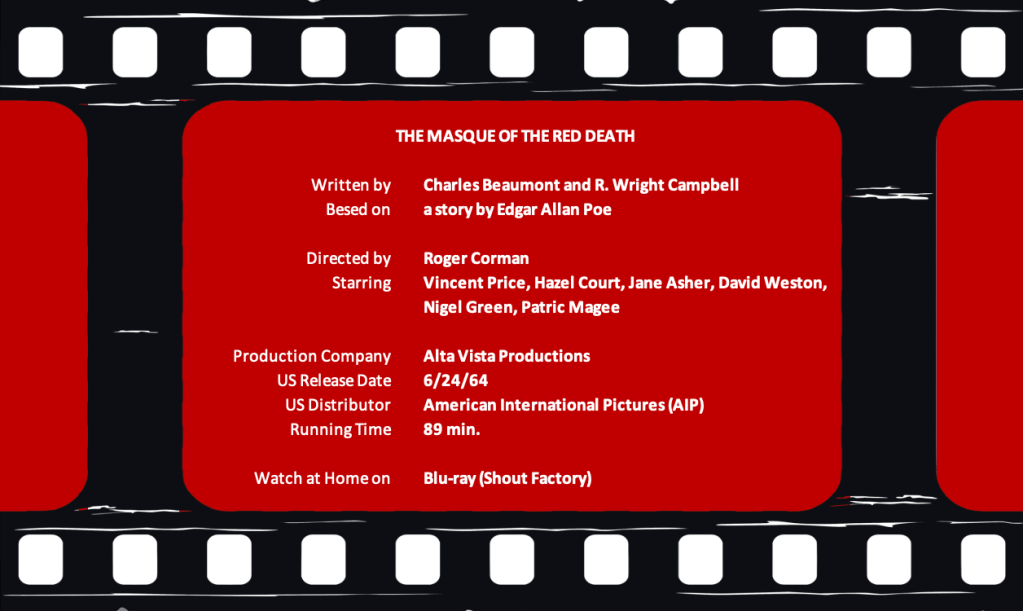
The seventh film out of Roger Corman’s eight-film cycle based on the works of Edgar Allan Poe, The Masque of the Red Death (1964) is perhaps the best, but not necessarily the most entertaining. In some ways, it’s Corman’s “art film,” with imagery that evokes The Seventh Seal (1957), a concern that prevented him from making it sooner than he did. Filming in England allowed the production more time and money, however…
…I’m not sure it looks any better than his previous Poe films, shot with less time and a smaller budget. Using BAFTA award-winning sets remaining from Becket (1964), the look of The Masque of the Red Death feels more “open” and less claustrophobic. In a way, though, it’s a more sprawling story that takes place not only in a castle, but also in a village infected by plague.
Vincent Price plays one of his more despicable characters, generating little to no sympathy for his actions. This is in part due to the fact that we know nothing about his past. Because he has no background, Prince Prospero is a more a personality than a character like Roderick Usher or Nicholas Medina. This means there’s less ambiguity, but possibly more investment in the outcome.
As plague sweeps the countryside, Prospero invites wealthy people from across the land to his castle for a ball, promising to protect them. He’s a stickler for the rules, not allowing one of his friends inside because he’s a bit tardy to the party. He’s also “rescued” the pretty young Francesca (Jane Asher) from the village, an action not surprising or unfamiliar to his wife, Juliana (Hazel Court.)
Juliana is more interested in performing ceremonies in the dungeon, marrying Satan, and offering him her soul. She probably thinks this will endear her to Prospero, who shows some interest in what she’s doing. However, he can’t see past Francesca, a distraction that may contribute to his fate. This is all creepier when you learn that Asher was only 17-years old at the time.
Francesca’s father, Ludovico (Nigel Green), and fiancee, Gino (David Weston), are also taken from the village and locked in the dungeon for Prospero to use as leverage toward getting Francesca to cooperate. I’m not sure what his plan for her is, but you can easily imagine it’s to bed her, then toss her aside like he’s probably done with other young women.
Luckily, the audience of this movie aren’t the only ones that recognize a villain when they see one. Most of the characters bow to his whims of humiliation, but two incorporated from another Poe story, Hop-Frog, devise a plan to unseat him during the ball. Big ideas come from little people, literally, as entertainers Hop Toad (Skip Martin) and Emeralda (Verina Greenlaw) unveil their surprise simultaneously to Prospero and to us.
Then things get a little surreal… creepy as can be, but surreal. Not surprisingly, the physical embodiment of the plague makes it into the castle and, one by one, people look like they’ve been bathed in blood as he brushes by each of them in the ballroom. The “Red Death” pursues Prospero through a series of colored rooms leading to the dungeon and Satan’s altar.
Woven consistently throughout the story is the idea that God is dead. Who could believe in the goodness of God in a world of famine, pestilence, war, disease, and death? They rule this world and Prospero is giddy about it. However, if there’s a positive spin on things, these forces of evil can ultimately have a life-affirming outcome. Consequently, The Masque of the Red Dead says something about faith. You gotta have it.

 Classic Horrors Club
Leave a comment