
October 11, 1957
- Blair Cunningham, rock drummer for Haircut 100, was born in Memphis,
- Dawn French, Welsh comedian and TV actress, was born in Holyhead, Wales, and…

For centuries, the prayers of Mexico’s peasants have been their only shield against the devastating furies that have wrecked their homes and destroyed their lives. And so today, again they kneel, terrified and helpless, as a new volcano is created by the mysterious and rebellious forces of nature. The Earth has split a thousand times. Whole acres of rich farmlands have cracked and dropped from sight. And millions of tons of molten lava are roaring down the slopes, in a quake recorded on the seismograph of the University of Mexico as the most violent of modern times. To the benighted citizenry of this remote countryside, the most alarming aspect of the phenomenon is the fact that its unabated hourly growth is without precedence, having reached a towering height of nine thousand feet within a few days. And with each added foot, it spreads its evil onslaught into a wider circumference. But what is now most feared is that rescue work will be severely hampered by the hazardous inaccessibility of the terrain.
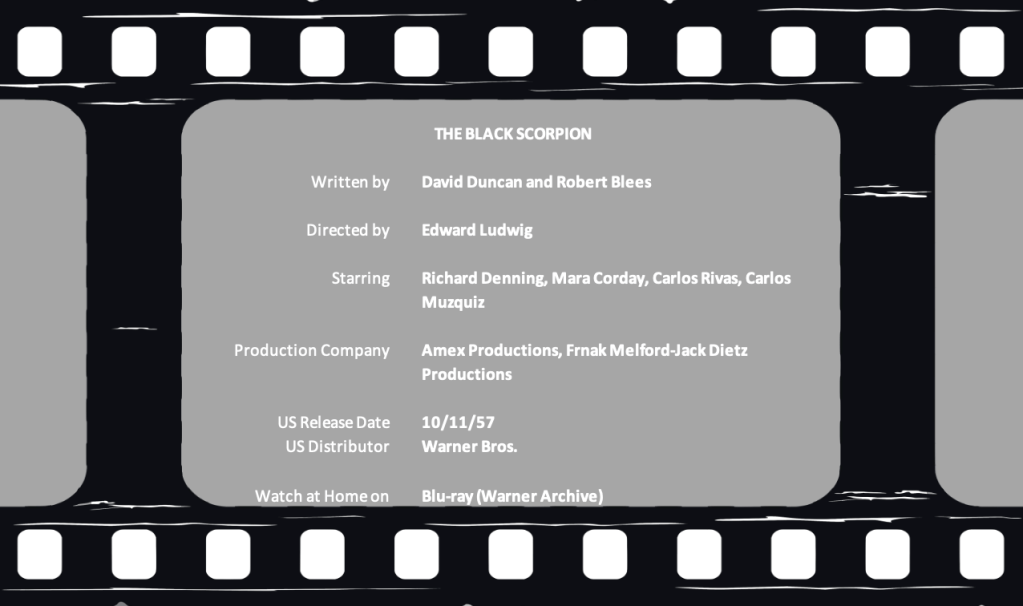
From what I knew of its reputation, I assumed The Black Scorpion (1957) was going to be a better than average “big bug” film. (Technically not insects, scorpions are cousins of spiders in the arachnid class, but I don’t think anyone wouldn’t call a giant spider movie a “big bug” movie.) I didn’t, however, imagine that it would exceed my expectations the way it did.
Sure, the story is pretty standard and has two endings, making it feel longer than its 88 minutes; however, the special effects are incredible! No, I’m not talking about the close-ups of a google-eyed scorpion with a drooling problem, but the stop-motion action of the scorpions in full body shots. Willis O’Brien (King Kong, 1933) played at least a part in filming them and they are spectacular.
I can’t emphasize this enough. Enhanced by the killing stabs of their tails, every move is magical. It doesn’t hurt that scorpions are creepy-crawly to begin, but I suppose how much you squirm in your seat depends upon how fond you are of them in real life. Picking up some movement in the 27 years since Kong, the camera swings and zooms in and out of the action, adding to the kinetic energy.
Again, the story is nothing to champion, but I appreciate that it’s nature, not nurture, that produces the monsters. They simply climb to the surface when a volcano blows; they aren’t produced by radiation or mad scientists. Plus, you have the reliable Richard Denning and the lovely Mara Corday in the leads, as a geologist and rancher investigating the volcano and the giant scorpions.
Hank Scott (Denning) and Teresa Alvarez (Corday) share a similar chemistry to Mitch MacAfee (Jeff Morrow) and Sally Caldwell (Corday) in another movie from 1957, The Giant Claw. (It must be easy to shoot sparks with Corday.) I enjoy both films, but if you could marry the story of The Giant Claw to the special effects of The Black Scorpion, you’d have the best Atomic Age sci-fi adventure of all time!

 Classic Horrors Club
Leave a comment