
October 3, 1965
- Ernie Banks and Don Kessinger combined to tie the MLB record of three triple plays in a season,
- The #1 song in the country was Yesterday, by The Beatles, and…
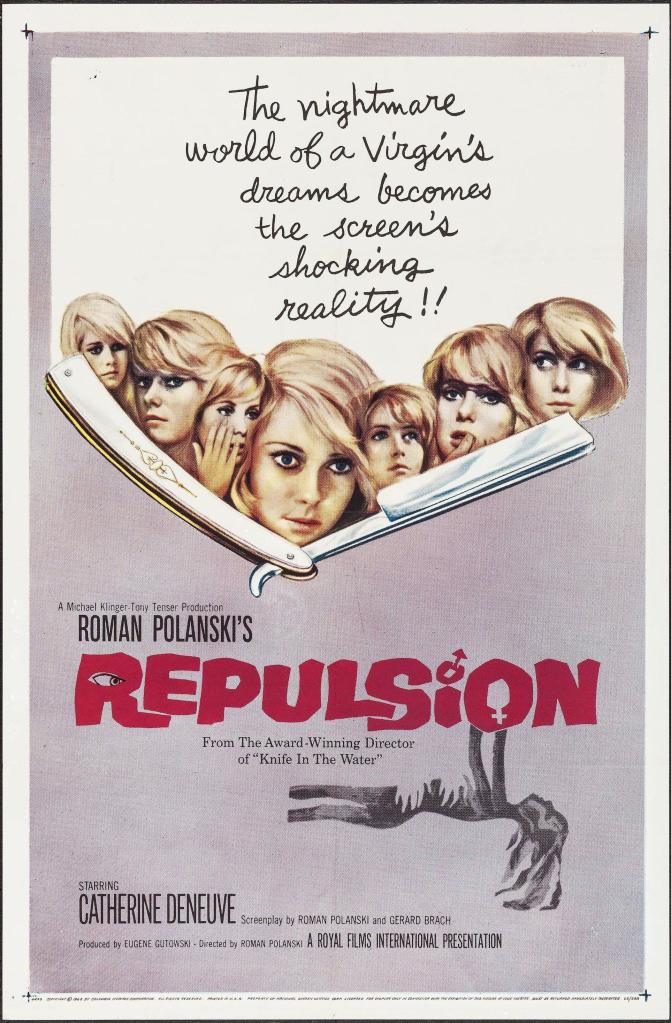
Purposeful or not, the opening of Repulsion evokes Psycho. However, instead of the camera slowly zooming-in on an eye, it slowly zooms out. This indicates we’re going to see events from the character’s (also a lovely blonde woman) point of view. At full frame, we immediately know something’s not right with Carol (Catherine Deneuve.) She has “spaced out” giving a manicure at the salon in which she works.
Several subsequent scenes of her walking along the city streets with the accompaniment of an increasingly erratic jazz score further represent the fact that she’s aimless, stuck inside her head and oblivious to the outside world. This includes her suitor, Colin’s (John Fraser), persistent attempts to catch her attention. He knocks on the pub window as she passes and is ignored. He kisses her after a dinner date and she runs into her apartment, brushing her teeth violently to remove any taste of him.
It’s clear that Carol is repulsed by anything related to sex, and perhaps men themselves. Her disgust is even more apparent as she witnesses her sister, Helen’s (Yvonne Furneaux) lover, Michael (Ian Hendry), as he cheats on his wife with her. When he puts his straight razor and toothbrush in her glass in the bathroom, she throws them in the trash. Worst of all, she listens to her sister’s moaning and groaning as they fornicate in the adjacent bedroom.
This was supposedly the first depiction of the female orgasm to be passed by the British Board of Film Censors. Pay attention to the details and you’ll miss some sly sexual references. To this one in particular, Michael asks Helen, in a hurry to leave the apartment, “Are you coming or aren’t you?” She replies, “Yes. Yes. I’m coming.” Such is the intricacy of the screenplay by Roman Polanski and Gerard Brach.
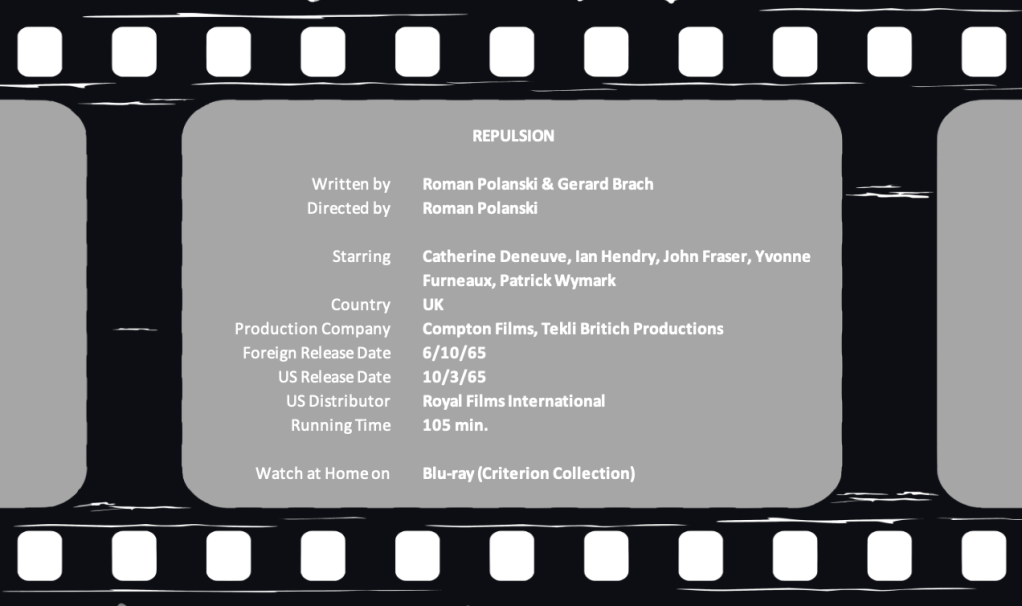
Polanski also directed, his first English language film and second full-length feature, following Knife in the Water (1962), which won the Academy Award for Best Foreign Language Film. In a way, Repulsion, demonstrates the talent of a filmmaker who’s not even trying. The movie was apparently a commercial means to an artistic end, made to generate funds for his pet project, Cul-de-sac (1966.)
It seems to me there’s been effort put into it and, if not, Repulsion is full of happy accidents. Sure, some elements could be considered obvious, even heavy-handed, such as walls in Carol’s apartment literally cracking as her mind does the same. However, others are subtle and sublime. You might not notice it at first, but pay attention to the sounds throughout the film. Bells, footsteps, ticking provide the soundtrack of Carol’s life.
Carol’s isolation when Helen and Michael go on holiday leads to depression and disturbing hallucinations in which she’s raped and hands emerge from the hallway to grope her. Eventually, she suffers a pair of schizophrenic outbursts in which she puts to bloody use Michael’s straight razor and a candlestick. She’s a non-discriminatory killer in which one of the victims is punished for trying to help her and one for trying to hurt her.
I’ve seen Repulsion twice. The first time was a revelation that the second couldn’t quite match. However, it’s without a doubt a psychological masterpiece full of incredible imagery and sound. It can be as emotionally deep as you make it. Pay attention to the final shot. A family photo appears several times during the film; however, a close-up of it provides a scary clue to events that we may not have even noticed.

 Classic Horrors Club
Leave a comment