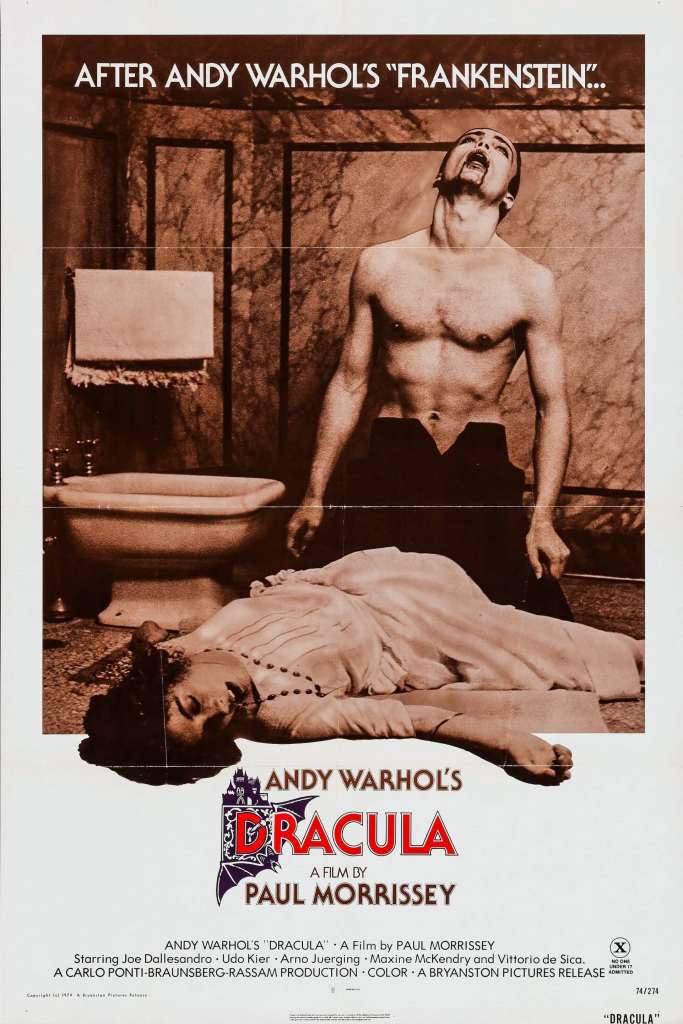
You don’t know me at all if you thought I wouldn’t turn right around and watch Blood for Dracula (1974) after Flesh for Frankenstein. While the two are similar, and I like them for the same reasons, this one feels more like a revelation because I didn’t first listen to Rod and Mark talk about it on a podcast. I may slightly prefer the situation around which the plot revolves in Blood of Dracula; it seems less like it will conclude with a punch line.
Dracula (Udo Kier) isn’t doing too well. He’s depleted the supply of virgins in Romania and, encouraged by his faithful servant, Anton (Arno Jurging), decides to travel to Italy to find a new bride. She must be a virgin and the joke is that of the four daughters in the house of Di Fiore, two of them are secretly sleeping with Mario (Joe Dallesandro.) When Dracula bites them, we graphically learn why “unclean” blood just won’t work.
Kier plays Dracula in the similarly crazed manner in which he played Frankenstein. He’s overly dramatic, but in a way that somehow belongs in the film rather than distracts from it. His line readings provide much of the humor, and I’d say the character is more in the forefront. This means you’re either going to love it/him or hate it/him. I view his Dracula as insecure, neurotic sad sack, and that’s certainly a fresh interpretation of the fearsome Count.
Both films share the upper-class disdain of the lower class. Often, the less fortunate are bluntly called, “trash.” More so in Blood for Dracula, the side of the underprivileged is seen through the eyes of Dallesandro’s character. He’s read all about the Russian Revolution and anticipates something similar happening in his neck of the woods. Interestingly, he doesn’t seem to do much about it other than simply wait.
Mario is crueler than Nicholas was in Flesh for Frankenstein. The disdain of another class flows both ways as he calls the sisters whores and sometimes acts violently toward them. He’s not as heroic, although he’ll eventually become the Van Helsing to Kier’s Dracula. He also seems different because his connection to the daughters is of a different nature than Nicholas’s connection to the “Male Monster.”
Blood for Dracula is sexier, but not as gory as, Flesh for Frankenstein. In a way, both are built around unique views about the physical act, but virginity is an ever-present point in the former, while procreation is a more intangible point in the latter. In both, sex seems ridiculous, perhaps commenting on prudish perceptions of it. I think the true meaning of the films lies here, rather in the obvious statement that the rich are monsters, although there is that, too. Rod? Mark?


 Classic Horrors Club
Leave a comment