Written by Jean Rollin & Christian Meunier
Directed by Jean Rollin
Starring Marie-Georges Pascal, Felix Marten
Released July 5, 1978 (France)
RT 85 min.
Home Video Redemption (multi-format)
Classic Horrors rating = 7 (out of 10)
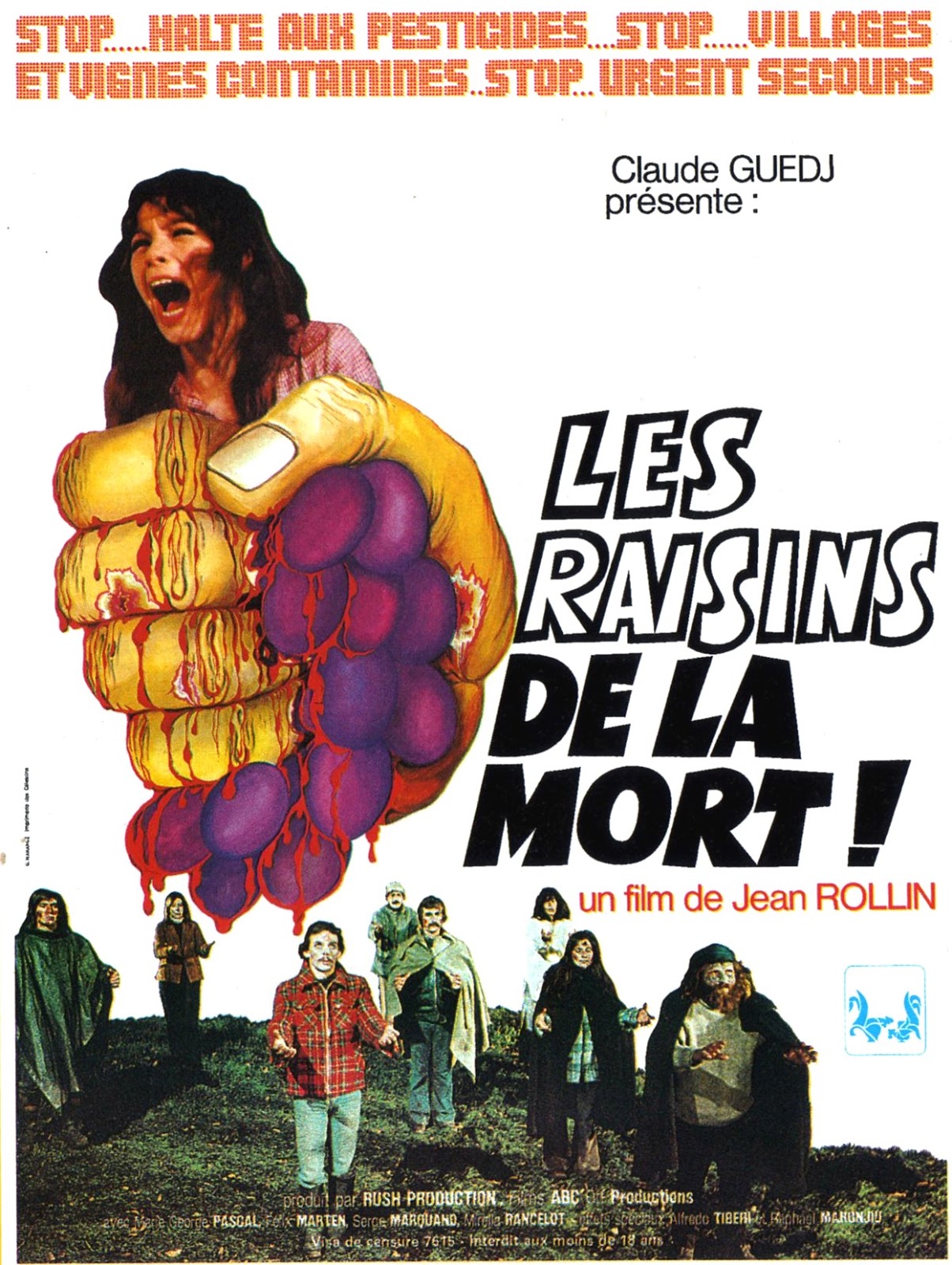
Don’t take away my Euro Horror-cred card, but The Grapes of Death (1978) is the first Jean Rollin film that I’ve seen, and I’m not sure it’s representative of the kind of movie for which he’s most recognized: erotic vampire films. (At least, with my limited knowledge of the man, that’s the type of movie for which I believe he’s most recognized.) Considered “the first French gore film,” this movie was apparently a departure for the director from his usual “dreamlike and poetic works.”
It was a huge success and has been compared in importance to George A. Romero’s Night of the Living Dead (1968), although the “zombies” in The Grapes of Death are not mindless eating machines. Instead, they’re normal people infected by the insecticide used on the grapes in a vineyard to become thinking creatures that suffer from their affliction. Watching it 50 years later (!), after countless zombie movies and television shows, how does it fare?
Other than perhaps its historical significance, I’m not sure I found it to be anything more special than just a pretty good zombie movie. The most memorable thing to me is a scene in which a man kills his infected daughter with a pitchfork. Pinned to the dining room table, it’s a terrific practical effect… she continues to breathe (for a while), her stomach inflating and deflating around the tines of the pitchfork. The camera lingers and it’s remarkably realistic.
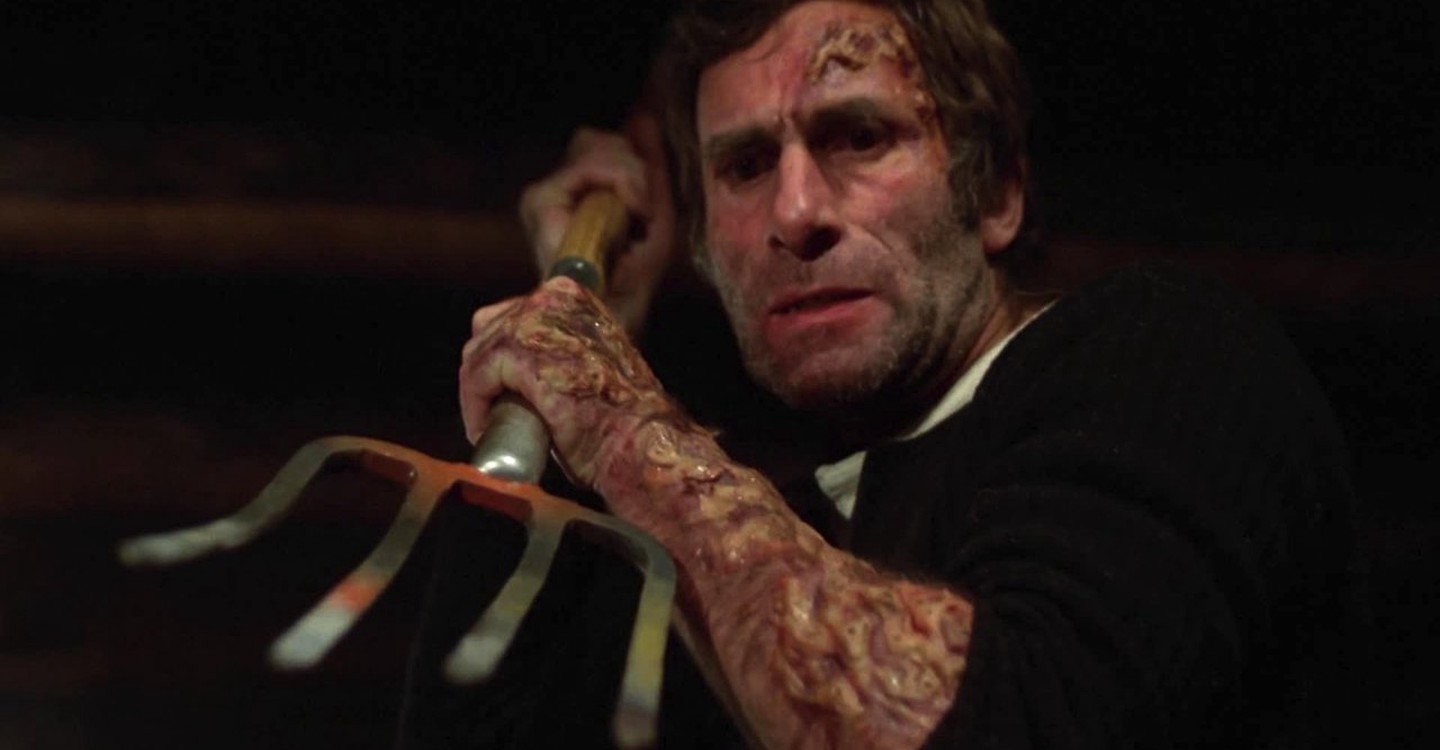
It’s a shame, because the makeup of the “zombies” themselves is mostly unbelievable, globs of makeup on top of skin that don’t seem organic. The believable thing about the “zombies” is the emotion that’s displayed as they murder their loved ones, as if they’re forced to do it against their will. Where I imagine Rollin’s sensibility is demonstrated is when a beautiful, curvaceous woman drops her gown to show that she has no sores on her body.
It could be deceiving, though. It seems that the males have more marks than the females, so you don’t really know who’s infected and who’s not. Elisabeth (Marie-Georges Pascal) doesn’t have time to discriminate. On board the train to the village, which is really “just a vineyard with some buildings around it,” a man with sores kills her travelling companion, Brigitte (Evelyne Thomas), in the bathroom. She has enough sense to run, with the man pursuing her across the countryside.
She thinks she finds shelter in the home of a man and his grown daughter, but this will become the scene of the aforementioned death by pitchfork, which happens after Elisabeth discovers the dead mother upstairs. Before any of that happens, though, there are a couple of exchanges like this:
Elisabeth, “May I use your phone?”
Daughter, “We don’t have one.”
Elisabeth, pointing to wall, “What about that one?”
Replace “phone” with “car,” then lather, rinse and repeat. Yeah, something funny’s happening. But Elisabeth isn’t dumb, a characteristic that may indeed elevate The Grapes of Death above and beyond the average zombie movie.
“What have I done?” asks the father after murdering his family. “This is tearing me apart.” He asks her to finish him off when she climbs in the supposedly non-existent car, so she obliges and rams him against the wall before driving off to find help. Instead of help, though, she finds Lucie (Mirella Rancelot), a blind woman stumbling along her way. She doesn’t know what happened at home, but there was fighting and her husband told her to leave.
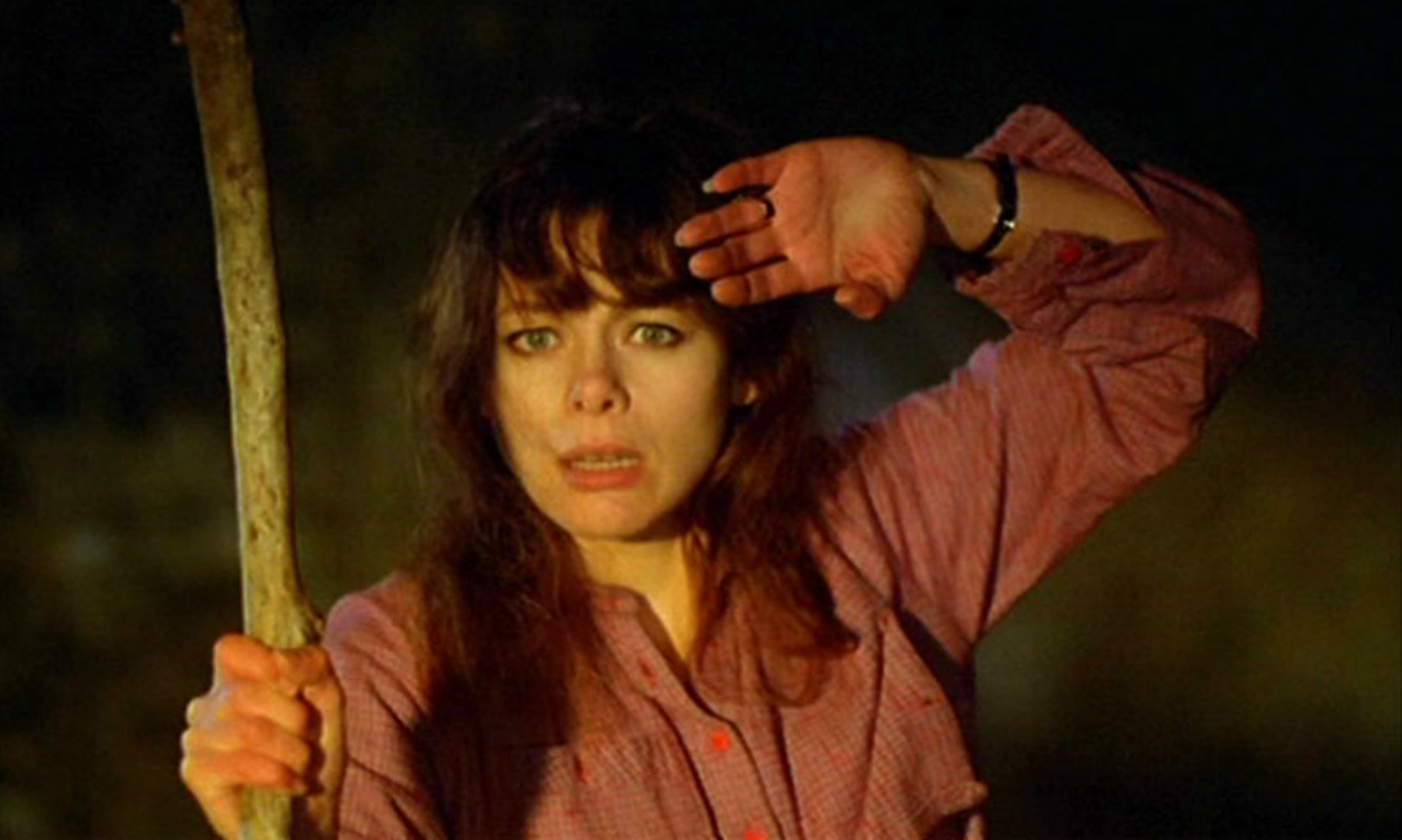
It’s interesting to see Elisabeth lead Lucie through deserted homes, trying not to tell her what she sees. Normally, characters are figuratively blind to what’s happening. In this one, Lucie is literally blind to what’s happening. Things don’t end well for her. I guess it’s always better to open your eyes and face what’s in front of you instead of burying your head in the sand to ignore it. That’s not the last we see of her, though. Her husband severs her head, carrying it with him throughout the rest of the movie.
Eventually, two construction workers appear in a pickup full of dynamite. Since they drank beer instead of wine at the grape festival, they seem to be immune. One of them takes great pleasure in gunning down “zombies,” and has a conversation with his pal that adds an underlying political tone to the proceedings. It’s a lot in a short period of time, but something about war not being for a country, but instead against Fascism. So late in the movie, I didn’t really want to consider the meaning.
More compelling (and relevant) to me was the notion that nobody alerted the authorities when all hell started breaking loose because the winery was employing illegal immigrants. You know, maybe I liked The Grapes of Death more than I originally thought. It has some really strong points. Overall, though, it’s made in a rather matter-of-fact manner. With more suspense and a quicker pace, I think I would have enjoyed it more.
 Classic Horrors Club
Leave a comment